

ChargePoint Launches Charger for Mass-Market EVs Amid Q1 Revenue Increase
The company’s revenue rose by 4.3% YoY
June 5, 2026


Follow Mercom India on WhatsApp for exclusive updates on clean energy news and insights
U.S.-based electric vehicle (EV) charging solutions company ChargePoint reported revenue of $101.8 million in the first quarter (Q1) of fiscal year (FY) 2027, a 4.3% year-over-year (YoY) increase from $97.6 million. Revenue for the quarter beat analysts’ expectations by $5.97 million.
The revenue growth reflects improved demand, continued customer confidence in its platform, and disciplined execution.
North America accounted for 80% of the quarter’s revenue, while Europe contributed 20%. In Europe, sales of fully electric cars in the main auto markets jumped by almost a third during the quarter.
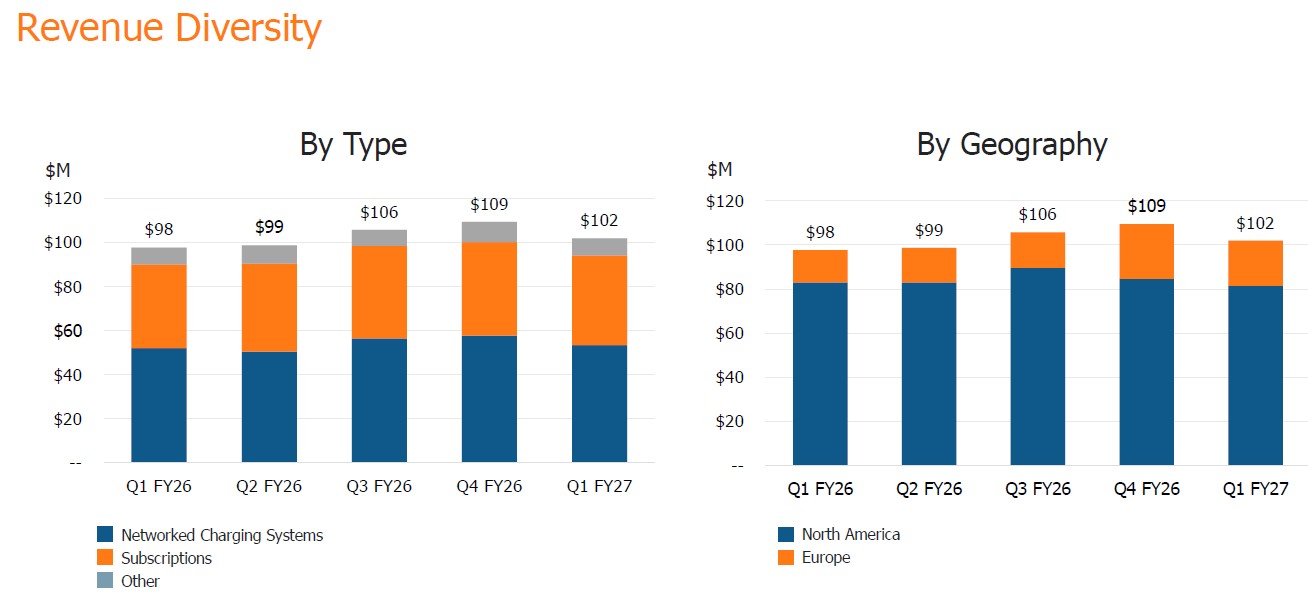
Revenue from networked charging systems stood at $53.3 million, up 2.3% YoY from $52.1 million. Subscription revenue rose 7.4% YoY to $40.8 million from $38 million.
The company’s net loss narrowed by 39% to $18.3 million from $30 million in the same quarter last year.
Its adjusted earnings before interest, taxes, depreciation, and amortization (EBITDA) loss narrowed by 16% to $19.2 million from $22.8 million in the prior-year quarter.
Earnings per share (EPS) loss came in at $1.75, compared to an EPS loss of $2.49 in Q1 FY 2026, beating the $0.27 estimate.
ChargePoint reported revenue of $109.3 million in Q4 of FY 2026, a 7% YoY increase from $101.9 million.
Business Highlights
Richard Wilmer, President, CEO & Director, said that the EV transition is accelerating, supported by the cost advantage of operating an EV compared with an internal combustion engine vehicle as gas prices rise.
He noted that EV purchase prices are becoming competitive with ICE vehicles, which is also driving demand. Used EVs are now near price parity with comparable gasoline vehicles, and their availability is increasing significantly.
He added that as AI-enabled mobility, autonomous transport, and distributed energy infrastructure scale, EV charging will become increasingly mission-critical.
During the quarter, software-only managed ports grew 3.8% to 135,000 from 130,000 in the previous quarter. Monthly active users were slightly above 1.48 million at the end of April.
The company now manages approximately 406,000 ports, up 5.5% from 385,000 in the previous quarter. This includes more than 44,600 DC fast chargers, up 8.8% from 41,000. It also has more than 145,000 ports in Europe, up 10.7% from 131,000.
Globally, ChargePoint drivers have access to over 1.41 million public and private charging ports, up 2.9% from 1.37 million in the previous quarter.
From a billings perspective, the first-quarter mix was 71% commercial, 14% fleet, 8% residential, and 7% other sources.
ChargePoint launched Express Solo, a standalone EV charger for mass-market passenger EVs. The charger claims to deliver up to 600 kW of charging speed to a single port and approximately 40% higher power density than competing solutions. The company said it expects the product to drive demand growth in both Europe and North America once it enters production.
It partnered with OBE Power to deploy approximately 2,500 charging ports at multifamily residences starting this year.
The company also secured one of its largest transit fleet orders to date, delivering DC fast-charging solutions to support Santa Monica’s transition to e-buses.
ChargePoint said artificial intelligence is becoming a meaningful advantage, not only in its own operations but also in the software capabilities it delivers to customers. It is using AI across software development, customer support, AI-enabled product capabilities, and business process automation.
The company expects to achieve further operating expense benefits as it continues enterprise-wide AI adoption. It added that upcoming product releases will expand AI’s role in helping customers manage, optimize, and monetize charging infrastructure.
For Q2 FY 2027, it expects revenue to range between $100 million and $110 million.
Raj Prabhu, CEO at Mercom Capital Group, said that in the last few years, smart grid funding has been driven by EV charging companies. According to Mercom Capital Group’s Q1 2026 Funding and M&A Report for Smart Grid, corporate funding for smart grid companies totaled $1.1 billion across 16 deals.


Melvin Mathew
More articles from Melvin Mathew.