

Chennai Data Center to Cut Power Bills With 974 kW Building-Integrated Solar
The project is expected to generate 700,000 units of electricity annually

Follow Mercom India on WhatsApp for exclusive updates on clean energy news and insights
Data centers are among the most power-intensive commercial facilities and require round-the-clock electricity to operate sophisticated computing infrastructure and cooling systems. As data center capacity expands in India, operators are increasingly exploring renewable energy to reduce dependence on conventional grid electricity, manage power costs, and lower emissions.
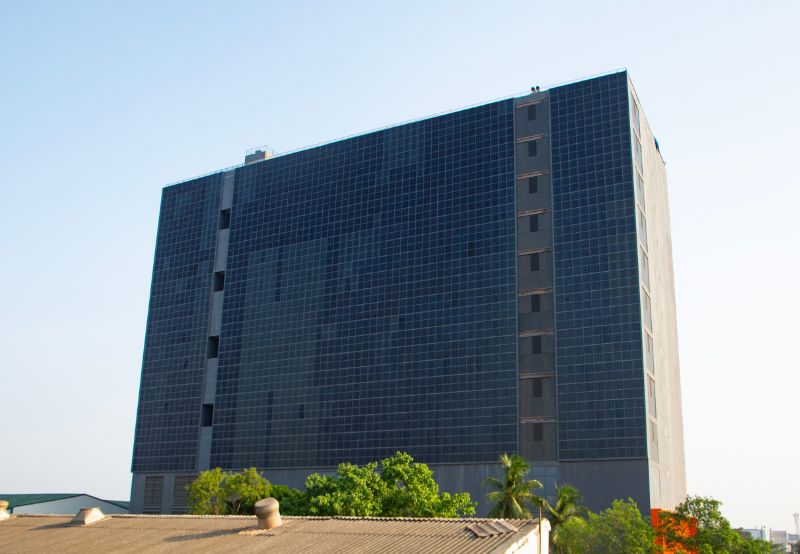
A newly constructed data center in Chennai, Tamil Nadu, has integrated a 974 kW building-integrated photovoltaic (BIPV) system into its façade to supplement its round-the-clock electricity consumption with onsite renewable energy.
The BIPV system allows the building envelope to accommodate solar generation while supplying electricity directly to continuously operating loads.
U-Solar Clean Energy Solutions handled the design, engineering, procurement, and execution of the solar installation for the data center operator.
Unlike conventional rooftop solar projects, where modules are mounted on an existing roof, the solar modules at the data center are part of the building façade.
According to U-Solar, the decision to integrate the solar power installation into the building façade was intended to reduce dependence on grid electricity, lower emissions, and support the data center operator’s sustainability objectives.
The solar project is expected to generate approximately 700,000 kWh of electricity annually. The entire generation will be consumed onsite, with no surplus electricity expected to be exported to the grid.
The project has an indicative payback period of around four to five years. U-Solar said BIPV project economics is evaluated differently from that of conventional rooftop or ground-mounted solar installations because the system forms part of the building envelope while also generating electricity.
The data center also uses diesel generator sets to provide backup power and maintain uninterrupted operations. U-Solar said onsite renewable generation has helped reduce the facility’s reliance on diesel-based backup power and fuel consumption.
The solar-powered system uses 846 Waaree 540 Wp modules and seven SolarEdge inverters with power optimizers.
The company estimates a specific yield of approximately 1.9 to 2 kWh/kWp/day. The relatively lower specific yield compared with a conventional rooftop solar installation is attributable to the façade-mounted BIPV configuration and module orientation.
Installing solar modules on the building façade also created execution challenges. Lifting, handling, and positioning modules at height required specialized installation methods and coordination with the site team.
U-Solar executed the installation in phases and followed safety and execution protocols to avoid disrupting the data center’s operations.
The company estimates that the project will offset approximately 635 metric tons of carbon dioxide emissions annually.
U-Solar had earlier commissioned an 8.5 MW ground-mounted solar project for Aster DM Healthcare in Kasargod, Kerala
Mercom India also hosts a pan-India C&I Clean Energy Meet series, bringing renewable energy developers and commercial and industrial power consumers together to discuss clean energy adoption. The next event in the series will be held in Hyderabad on August 21, 2026.


Arjun Joshi
More articles from Arjun Joshi.