

China Sets New Minimum Efficiency Thresholds for Solar Modules, Inverters
The efficiency standards will be applicable from January 1, 2027
July 13, 2026

Follow Mercom India on WhatsApp for exclusive updates on clean energy news and insights
China has rolled out new minimum efficiency standards for components across the solar manufacturing value chain covering polysilicon, wafers, modules, and inverters. The standards will take effect on January 1, 2027.
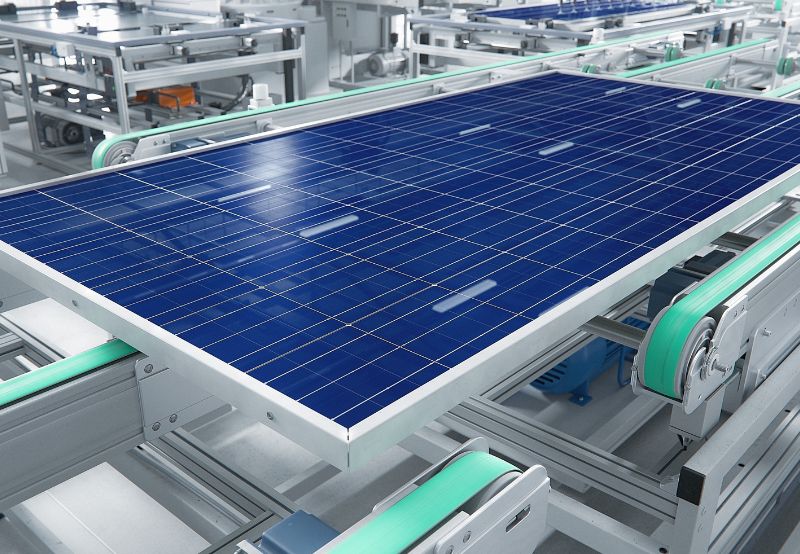
For TOPCon and HJT modules, the minimum efficiency is set at 23.2%. The minimum efficiency standard for back-contact solar modules is 23.5%.
It also introduces minimum conversion efficiency standards for solar inverters above 20 kW.
The standard does not apply to BIPV modules, consumer photovoltaic modules, and perovskite/crystalline-silicon tandem modules.
For polysilicon produced using the Siemens process, the new standard sets maximum energy consumption thresholds of ≤5.0 kg of standard coal equivalent per kilogram or kgce/kg for Grade 1, ≤5.5 kgce/kg for Grade 2 and ≤6.4 kgce/kg for Grade 3.
For a fluidized bed reactor (FBR) or an FBR with granular polysilicon, the corresponding thresholds are ≤3.6 kgce/kg, ≤4.0 kgce/kg, and ≤5.0 kgce/kg, respectively.
For monocrystalline silicon wafers with 182 mm × 210 mm specifications, the standard energy consumption limits are ≤2.27 kgce/kg for Grade 1, ≤2.37 kgce/kg for Grade 2, and ≤2.76 kgce/kg for Grade 3.
The National Standardization Administration has approved the new efficiency standards and consumption thresholds under GB 47834-2026, GB 29447-2026 and GB 47835-2026.
The standards fall under the jurisdiction of the National Standardization Administration. They are implemented by TC20 (National Technical Committee on Standardization of Energy Infrastructure and Management).
In June 2026, China’s National Energy Administration (NEA) issued measures setting minimum targets for renewable energy consumption in critical energy-intensive industries and assigning responsibility weights for renewable power consumption to provincial-level administrative regions.
China expanded its installed solar power capacity by 41.4 GW in the first quarter of 2026. On a year-over-year basis, solar capacity addition dropped 41.7% from 70.97 GW. The country’s cumulative installed power generation capacity reached 3,960 GW by the end of March 2026, a 15.5% YoY increase, according to data released by the NEA.
In January 2026, China’s State Administration for Market Regulation (SAMR) issued compliance guidance in Hefei, Anhui Province, to regulate the order of price competition in the solar photovoltaic (PV) industry. SAMR briefed participants on price-related violations and risk issues in the PV sector, noting that current problems, such as low-quality competition and homogeneous, repetitive capacity expansion, have led to widespread profitability issues.


Melvin Mathew
More articles from Melvin Mathew.