

Choosing the Right Solar Supplier Is No Longer Just About Price
Industry leaders say quality, engineering, after-sales support, and automation will increasingly differentiate suppliers as India's domestic solar manufacturing ecosystem matures
August 5, 2026

Follow Mercom India on WhatsApp for exclusive updates on clean energy news and insights
As India accelerates the transition to domestically manufactured solar cells and modules, manufacturers and developers are increasingly prioritizing supply chain readiness, engineering support, and technology adoption over equipment price alone.
The Ministry of New and Renewable Energy has allowed net-metering and open access solar projects commissioned by December 31, 2026, to continue using solar cells that are exempt from the ALMM List II requirement. Industry experts say developers should use the transition period to identify suppliers capable of consistently delivering domestic content requirement (DCR)-compliant modules. Once the exemption expires, demand for compliant modules is expected to increase sharply, making early supplier qualification increasingly important.
Addressing concerns about higher-priced ALMM-II-compliant modules, Kugarthi Raja Kumar, General Manager, Sales and Marketing (South), Saatvik Green Energy, said DCR modules command a premium because India’s manufacturing ecosystem remains in the early stages of development. Limited production scale, stabilizing manufacturing lines, and higher raw material costs continue to support higher prices.
Kumar expects prices to stabilize within the next six to twelve months as additional domestic cell capacity comes online.
Experts said long-term product quality and lifecycle support are becoming more important purchasing criteria than upfront price alone. Manufacturers capable of providing this support are likely to gain a competitive advantage.
Kumar said developers should evaluate module suppliers based on product certifications, factory audits, long-term warranty support, spare parts availability, and field service capabilities.
Growing Focus on BoM Quality
The bill of materials (BoM), comprising junction boxes, connectors, and cables, represents only a small share of overall project costs but can play a critical role in plant safety, reliability, and long-term performance.
Srivatsa, General Manager, Sales and Technical Operations at GenX PV, said that engineering, procurement, and construction (EPC) companies should prioritize certified components, verify connector compatibility, evaluate environmental durability, and ensure that electrical ratings are compatible with higher-voltage systems.
He warned that incompatible connectors can increase contact resistance, leading to overheating, moisture ingress, corrosion, plant outages, and warranty disputes. Rising module power ratings are driving demand for higher-current connectors and junction boxes capable of supporting 1,500 V and emerging 2,000 V systems.
Robotic Cleaning Solutions
Developers are also using automation to improve operating efficiency and reduce maintenance costs. Ground-mounted projects facing labor shortages and water constraints are increasingly adopting robotic dry-cleaning systems.
According to Suraj Vernekar, Managing Director at Aegeus Technologies, developers are evaluating fully autonomous, semi-autonomous, and hybrid cleaning solutions based on site conditions, plant size, terrain, and row length.
He said that while robotic dry-cleaning costs ₹0.35 (~$0.004) to ₹0.60 (~$0.006) per module, about one-third the cost for conventional manual water-based cleaning, reducing water usage and labor requirements. Lower operating costs enable developers to clean modules more frequently, improving generation by an estimated 0.75% to 1%.
Depending on site conditions and electricity tariffs, the payback period for robotic dry-cleaning systems can range from six months to two years for smaller projects.
However, Vernekar said cost savings are only one consideration. Some developers also deploy robotic cleaning to support broader ESG objectives.
Semi-autonomous robotic cleaning systems are typically preferred where securing contiguous land parcels is difficult. Vernekar said that 60%–70% of projects deploy hybrid systems, depending on soil conditions and whether the modules are arranged in long rows.
While such module cleaning solutions are taking root in ground-mounted projects, they have yet to gain traction in the rooftop solar segment.
To provide lighter solutions for rooftop systems, Vernekar said Aegeus has developed lightweight robotic cleaning systems weighing about 18 kg. The company is also preparing to commercialize a lighter 10-11 kg version later this year to improve accessibility and worker safety.
AI Integration in Solar Manufacturing
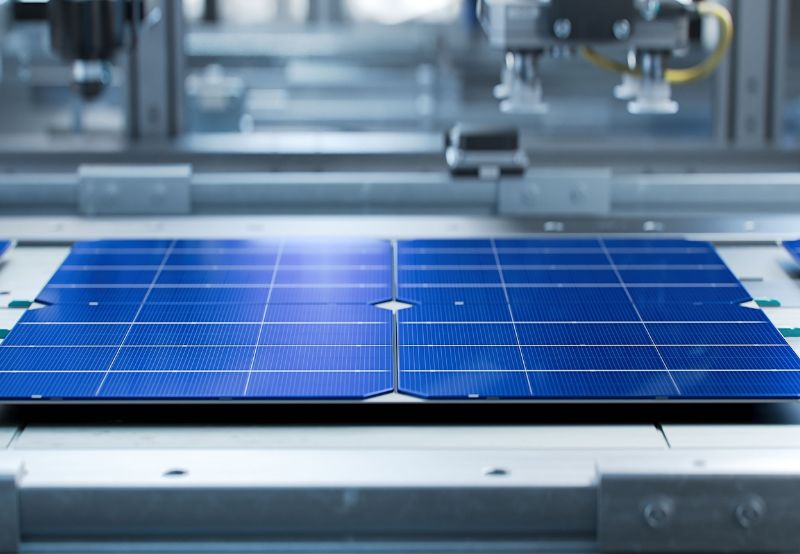
Artificial intelligence (AI) is increasingly being deployed throughout the manufacturing value chain.
AI-based inspection systems identify cell cracks, lamination defects, and other production anomalies in real time, improving throughput while maintaining quality.
Automation has increased Saatvik’s production capacity from approximately 5,000 modules per day to up to 8,000.
AI is also improving junction-box manufacturing by automatically identifying defects in crimping, welding, and assembly before products leave the factory, added Srivatsa.
Vernekar said beyond cleaning, Aegeus is developing AI-powered inspection systems that use thermal and RGB imaging to identify faults in modules, junction boxes, and electrical equipment.
The company is also developing AI-driven software to automate broader solar plant operations and maintenance, reduce manual intervention, and improve the project’s capacity utilization factor.
Despite these advances, manufacturers emphasized that AI complements rather than replaces manual quality inspections.
These were part of the discussions at Mercom India’s RE Buyer Seller Meet held in Bengaluru on July 24, 2026. The panelists highlighted that India’s solar market is becoming increasingly quality-driven, with developers placing greater emphasis on product reliability, engineering support, lifecycle costs, automation, and long-term supplier capability as domestic manufacturing expands under ALMM.
Mercom’s RE Buyer-Seller Meets connect manufacturers and solution providers with qualified installers, EPC contractors, developers, dealers, and distributors actively evaluating solar modules, inverters, storage systems, and balance-of-system products. Beyond showcasing products, the events provide practical market insights into evolving technology, procurement trends, and customer requirements.
The next RE Buyer-Seller Meet will be held on August 20, 2026, in Hyderabad.


Melvin Mathew
More articles from Melvin Mathew.