

C&I Battery Storage Economics is Tied to Value Stacking: Interview
Data centers could become one of India's most important C&I BESS markets
September 4, 2026

Follow Mercom India on WhatsApp for exclusive updates on clean energy news and insights
Battery energy storage systems (BESS) are evolving from backup power solutions into active energy management assets for commercial and industrial (C&I) consumers. Peak demand management, tariff optimization, renewable energy integration, diesel generator (DG) optimization, and resilience are emerging as potential value streams.
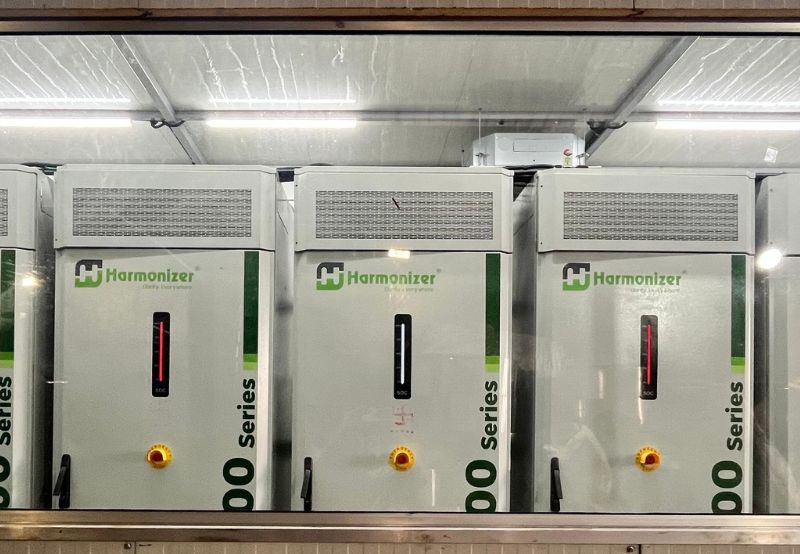
In an interview with Mercom India, Chintan Shah, Director at Harmonizer Energy, discusses the economics of C&I storage, lessons from an operational industrial microgrid, battery sizing and degradation, energy management systems (EMS), regulations, and the potential for data centers to drive BESS adoption.
How is the business case for C&I battery storage evolving, and which applications currently deliver the most measurable economic value?
We see a clear shift in the C&I market, from viewing BESS purely as a backup to considering it as an active energy management asset.
The most tangible economic value comes from peak demand management, tariff optimization, and renewable energy integration. BESS can charge during low-cost periods and discharge when electricity is more expensive. For facilities with rooftop or captive solar installations, excess power generation can be shifted to periods of higher demand or grid electricity prices.
DG optimization can also reduce fuel, maintenance, and operating costs. The strongest business cases come from value stacking, where the same BESS addresses peak demand, renewable energy utilization, tariff optimization, DG efficiency, and resilience.
What has the Bhandgaon solar-storage microgrid taught you about battery sizing, dispatch, load forecasting, and actual savings compared with design-stage assumptions?
The Bhandgaon project has given us operating experience with a 600 kW/1.2 MWh BESS integrated with 500 kW of solar, a 600 kVA DG, and an approximately 400 kW load.
A key learning is that BESS sizing must reflect the actual operating profile and intended application. Battery cycling has broadly matched design stage expectations, validating the initial sizing assumptions. We have also maintained solar operations during grid failure, with the BESS establishing the voltage and frequency reference needed for solar generation.
However, the large savings we expected from peak demand events initially did not materialize. Our assessment indicated savings of approximately ₹500,000 (~$5,291)/month, but our actual savings were around ₹400,000 (~$4,233)/month. This highlights the need to continuously measure BESS economics against operating data and refine dispatch strategies.
What determines the commercial viability of BESS for industrial consumers, and which load, tariff, solar, and operating characteristics have the greatest impact on project economics?
No single battery price or project size makes BESS commercially viable. Economics depend more on the facility’s operating profile and the value streams available.
Load profile, magnitude and timing of peaks, demand charges, time-of-day tariffs, solar generation, operating hours, and DG usage influence viability.
How are Maharashtra’s time-of-day tariffs, demand charges, storage requirements, and renewable energy regulations influencing C&I investment decisions?
Maharashtra’s regulatory environment is an important catalyst for C&I energy management.
Time-of-day tariffs create opportunities to charge storage when renewable electricity is available and economically attractive and discharge when energy has greater value. Demand charges similarly create opportunities where peaks are predictable. The Energy Storage Obligation indicates the broader market direction, with storage becoming integral to renewable energy planning.
C&I consumers are, therefore, increasingly evaluating solar, BESS, grid tariffs, and load profiles as an integrated energy system.
What common mistakes are C&I consumers making in BESS sizing and system design, and how can poor assessment or integration affect project returns?
A common mistake is treating BESS sizing simply as a kWh calculation. Power rating, energy capacity, operating profile, C-rate, usable SOC window, degradation, and intended applications must be considered together.
Another mistake is sizing batteries based on solar capacity rather than actual load and energy flows. Customers must also consider system efficiency, existing solar infrastructure, protection systems, transformers, metering, communication, and control philosophy.
Poor assessment can significantly affect returns. Oversized batteries leave capacity underutilized, while undersized systems may fail to capture intended savings. BESS should therefore be sized from the customer’s energy profile first and the battery catalog second.
How much do EMS and dispatch strategies influence C&I storage economics compared to battery hardware costs, and how sophisticated will energy management need to become?
Battery hardware remains a significant part of project economics, but the EMS and dispatch strategy determine how much value is extracted from it.
The same BESS using different dispatch strategies can produce very different economic outcomes. The EMS must understand load, solar generation, grid imports, tariffs, battery SOC and degradation, DG status, and operating requirements.
As systems become more complex, EMS will increasingly forecast load and renewable generation, anticipate tariffs, maintain reserves, account for degradation, and coordinate grid, solar, BESS, and DG in real time. The battery determines system capability; the EMS determines how intelligently it is monetized.
How should C&I consumers account for degradation, augmentation, changing load profiles, replacement costs, and residual value when evaluating BESS lifecycle economics?
Degradation should be treated as an economic variable, not simply a warranty parameter. It should be modeled according to actual duty cycles, including depth of discharge, number of cycles, operating temperature, and state of charge.
Augmentation costs and timing should be included in the original financial model, along with changing load profiles, component and battery replacement costs, O&M, and residual value.
How significant are power quality issues for Indian manufacturers, and can avoiding production losses materially improve BESS economics?
For many Indian manufacturers, power quality can be more economically significant than electricity bills suggest.
BESS can respond quickly to disturbances and support critical loads. However, it is not the solution to every power quality problem; active harmonic filters may be more appropriate for specific issues.
The key is quantifying interruption costs, including lost production, material wastage, restart time, equipment stress, and quality rejection. Avoiding even a few high-impact interruptions can materially improve BESS economics.
What changes in financing, safety standards, tariffs, interconnection rules, and business models are needed to make C&I storage a mainstream investment?
The next phase of C&I BESS adoption requires the ecosystem around batteries to mature alongside the technology.
Financing structures need to recognize storage’s multiple value streams. Longer tenure financing, leasing, energy-as-a-service, and battery-as-a-service can reduce upfront investment requirements.
Clear, consistent safety requirements; predictable interconnection processes; tariffs that recognize the time value of electricity; standardized performance measurement; and flexible ownership models are also important. Mainstream adoption depends on these elements maturing together.
What role can behind-the-meter storage play in addressing data centers’ load volatility, power quality, grid constraints, and backup needs, and could data centers become a major C&I BESS market in India?
We believe data centers could become one of India’s most important C&I BESS markets, particularly as AI and high-density computing change load characteristics.
BESS can respond rapidly to grid disturbances, manage short-duration load fluctuations, support power quality, reduce instantaneous demand on constrained grid connections, and help align renewable generation with consumption.
We do not see BESS replacing the complete backup architecture. Data centers will typically require multiple layers, including UPS, BESS, DG or other generation, grid supply, protection, and controls.
The opportunity is to make BESS an active part of electrical infrastructure. During normal operation, it can manage demand and optimize renewable energy; during disturbances, it can provide resilience; and at the system level, it can help data centers operate within grid-capacity constraints.


Arjun Joshi
More articles from Arjun Joshi.