

Experts Emphasize Synchronizing Transmission and Power Generation Planning
Supply chain constraints and RoW challenges are delaying transmission projects
July 9, 2026

Follow Mercom India on WhatsApp for exclusive updates on clean energy news and insights
As India expands renewable energy capacity, industry stakeholders say right-of-way and land acquisition challenges continue to limit visibility on project timelines, slowing grid infrastructure expansion.
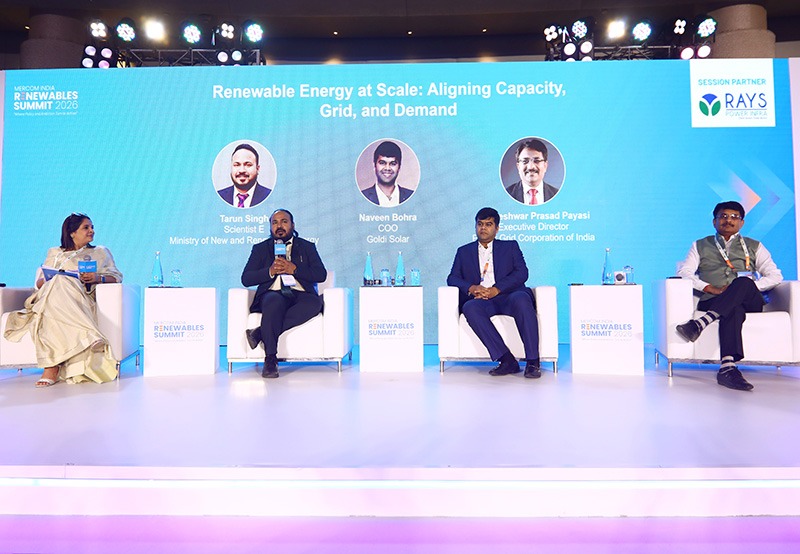
At the session “Renewable Energy at Scale: Aligning Capacity, Grid, and Demand” at the Mercom India Renewables Summit 2026, panelists discussed grid readiness for renewable energy expansion, supply chain constraints, and the renewable energy industry’s growing responsibility in maintaining grid stability.
Speakers emphasized the need for coordinated planning across transmission, manufacturing, and generation to sustain the sector’s growth momentum.
Opening the session, moderator Priya Sanjay, Managing Director at Mercom India, highlighted that India’s renewable energy project pipeline now stands at approximately 350 GW, led by hybrid projects accounting for 55% of the pipeline, followed by standalone solar at 39% and wind at 6%. However, despite this rapid capacity expansion, developers continue to identify transmission availability as one of the biggest execution risks.
Responding to concerns about transmission readiness, Tarun Singh, Scientist E at the Ministry of New and Renewable Energy (MNRE), said renewable energy has evolved from an isolated generation source to an integral part of India’s power system. While renewable energy generation has expanded rapidly over the past 15 years, transmission infrastructure requires significantly longer development timelines.
Singh said the Central Electricity Authority (CEA) first prepared a transmission plan aligned with India’s 500 GW non-fossil fuel target for 2030, identifying renewable energy-rich zones and corresponding transmission corridors. After MNRE identified the additional renewable energy potential beyond the original 500 GW target, CEA began planning transmission infrastructure for future capacity additions.
Singh added that CEA has also completed studies examining India’s power system requirements through 2035-36, estimating nearly 980 GW of renewable capacity based on state resource adequacy assessments.
However, Singh said renewable deployment could exceed even these projections as electricity demand accelerates from green hydrogen production, data centers, and other energy-intensive industries.
Expanding Transmission Network
Singh said that while early renewable integration depended primarily on interstate transmission systems (ISTS), future expansion will increasingly rely on Green Energy Corridors (GEC) within states.
Green Energy Corridor Phase-I was originally designed to evacuate approximately 24 GW but currently serves about 26 GW of renewable capacity. Phase-II covers another 20 GW, while the upcoming Green Energy Corridor Phase-III is expected to significantly expand transmission infrastructure, extending beyond traditional renewable-rich states into new regions.
Future phases of the program would focus on states that are not traditionally renewable-rich to reduce congestion in Rajasthan and Gujarat.
Singh noted that attention is shifting toward intrastate transmission because all premium locations near substations in renewable-rich states are being occupied. Going further inland through Green Energy Corridors will help distribute renewable generation more efficiently and reduce congestion.
Land and Right-of-Way Challenges
Developers often cite land acquisition and right-of-way issues as primary causes of delays in transmission projects.
Acknowledging the constraints, Singh said that transmission projects typically require three to five years to complete, considerably longer than renewable generation projects, and often encounter unforeseen obstacles during execution.
To address these issues, he said that the Ministry of Power has introduced land compensation policies and encouraged states to adopt standardized compensation mechanisms for landowners affected by transmission projects.
Singh noted that future transmission planning is increasingly utilizing the PM Gati Shakti platform to identify environmental constraints and minimize implementation delays before transmission projects begin.
Unutilized Transmission Capacity
Gyaneshwar Prasad Payasi, Executive Director at Power Grid Corporation of India (POWERGRID), cited examples of transmission infrastructure developers facing the problem of unutilized capacity because of delays generation capacity coming online. He cited the example of the Kurnool project, where POWERGRID built 8,000 MVA of transformation capacity that currently carries only about 10 MW of load. Another substation in Ananthapuram with 3,500 MVA of transmission capacity has no connected renewable energy projects.
Payasi added that while transmission projects worldwide take six to ten years, some projects in India are being completed in as little as nine months.
However, he highlighted that transmission assets currently operate at relatively low utilization at 25% because solar generation is concentrated during daylight hours.
Panelists suggested that policymakers reconsider how transmission capacity is allocated across solar and non-solar hours, enabling higher utilization without requiring proportional investment in additional transmission infrastructure.
They also felt that renewable generation should become more geographically distributed rather than concentrated exclusively in renewable-rich states.
Payasi noted that if every district develops renewable generation roughly equivalent to its own electricity demand, much of the transmission burden can be reduced because generation occurs closer to consumption.
Addressing concerns about large-scale renewable energy curtailment, including the reported 9 GW tripping incident at the Khavda renewable energy park, he said renewable generators must help maintain grid stability.
He recommended mandatory audits of grid compliance before renewable projects are commissioned, including verification of low-voltage ride-through, high-voltage ride-through, and fault ride-through capabilities.
Payasi also highlighted the growing need for synchronous condensers and ancillary services to support grid stability as inverter-based renewable generation becomes a larger share of India’s electricity mix.
However, he noted that synchronous condensers are estimated to cost ₹40 million (~$418,804)/MW to ₹ 60 million (~$628,206)/MW in India, compared with around ₹40 million (~$418,804)/MWp for renewable generation.
Supply Chain Constraints
While the solar manufacturing sector expects some constraints in the cell supply chain, panelists said that transmission infrastructure faces significant bottlenecks.
Payasi noted that India currently has only 700 to 800 transmission line erection teams, which are also servicing overseas projects.
Transformer manufacturers require nearly two years to deliver equipment, while specialized components such as pre-insertion resistor circuit breakers are manufactured by only two companies globally, both of which have two-year lead times.
He added that gas-insulated switchgear manufacturing capacity remains limited within India, further extending project timelines.
Calls for Better Coordination
While transmission developers highlighted stranded capacity caused by delayed generation, module manufacturers said India’s solar manufacturing capacity is keeping pace with demand, but there is a need for better coordination with the renewable energy sector.
Naveen Bohra, COO at Goldi Solar, said India’s current challenge is less about manufacturing capacity and more about aligning the demand and supply in the entire renewable ecosystem. Drawing a comparison with China, he said that country installs roughly 250 GW annually and has built corresponding infrastructure to support deployment.
India has rapidly expanded module manufacturing over the past two years, but Bohra said infrastructure planning has not kept pace.
Addressing concerns about India’s rapidly expanding module manufacturing capacity, he said the apparent oversupply reflects delays in transmission infrastructure rather than excessive manufacturing capacity and added that India’s solar manufacturing sector should prepare for export markets while realigning domestic demand and supply.
He also noted that India currently lacks sufficient skilled manpower for module and cell manufacturing and called for stronger collaboration between industry, universities, and government to develop specialized training programs.]To address the skills gap, Goldi Solar has partnered with educational institutions to introduce practical manufacturing certification programs that familiarize students with module production before they enter the workforce.
Bohra said China became globally competitive by combining scale with quality. India has already created manufacturing capacity, but the next stage of renewable energy growth must focus on quality, innovation, R&D, and skilled talent.



Melvin Mathew
More articles from Melvin Mathew.