

Fall in Battery Hardware Resales Pulls Stem’s Q2 Revenue Down 12% YoY
The company reported a net loss of $14.38 million
August 14, 2026


Follow Mercom India on WhatsApp for exclusive updates on clean energy news and insights
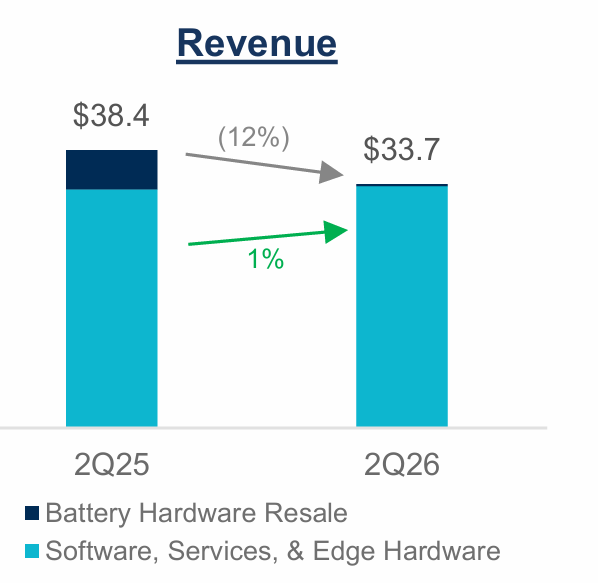
Energy storage company Stem’s revenue fell 12.3% year-over-year (YoY) to $33.65 million in the second quarter (Q2) of 2026 compared with $38.37 million, missing analysts’ estimates by $2.99 million.
The company attributed the revenue decline to lower battery hardware resales and managed services revenue. Battery hardware resale revenue fell 94.7% YoY to $300,000 in Q2 2026 from $5 million in the corresponding quarter last year. Managed services revenue fell 34% YoY to $5.89 million from $9 million.
Excluding battery hardware resales, revenue from software, services, and edge hardware increased 1% YoY to $33.4 million. Edge hardware revenue grew 22% YoY to $14.75 million.
Adjusted earnings before interest, taxes, depreciation, and amortization (EBITDA) increased 63.1% YoY to $6.23 million compared to $3.82 million. The improvement was primarily driven by a higher share of high-margin software and services revenue and lower operating expenses.
The company reported a net loss of $14.38 million compared to a net income of $202.53 million in Q2 2025. The prior-year quarter included a $220.05 million gain on the extinguishment of debt.
Stem’s earnings per share (EPS) loss came in at $1.58 compared to an EPS loss of $1.79 in the corresponding quarter last year. The EPS beat analysts’ expectations by $0.47.
1H Results
For the first half (1H) of 2026, Stem reported revenue of $62.65 million, down 11.6% YoY compared to $70.89 million.
Services and other revenue declined 3.3% YoY to $37.29 million compared to $38.57 million. Hardware revenue fell 21.5% to $25.36 million compared to $32.31 million in the corresponding period last year.
Adjusted EBITDA stood at $8.23 million compared to an adjusted EBITDA loss of $810,000 in 1H 2025.
The company reported a net loss of $33.31 million compared to a net income of $177.53 million in the corresponding period last year.
EPS loss came in at $3.78 compared with an EPS loss of $4.54 in the same period last year.
Business Highlights
Stem reported bookings of $36.8 million in Q2 2026, up 7% YoY compared with $34 million.
Contracted backlog increased 18% sequentially to $27.1 million at the end of the quarter compared to $23 million at the end of Q1 2026.
Contracted annual recurring revenue increased 3% sequentially to $69 million compared to $67.2 million.
PowerTrack annual recurring revenue increased 3% sequentially to $42.8 million. Managed services annual recurring revenue increased marginally to $19.6 million from $19.5 million.
Solar operating assets under management increased 2% sequentially to 38.3 GW, while storage operating assets under management rose 6% to 1.8 GWh.
Stem said that its PowerTrack energy management system (EMS) is booked across three continents. The company said Solarmarkt Group and its engineering, procurement, and construction partner, Pannonwatt Energetikai Megoldások, selected its PowerTrack energy management system as the integrated energy management, power plant control, and supervisory control and data acquisition platform for two hybrid solar-and-storage projects in Hungary.
Each project is expected to add a 40 MW/80 MWh battery energy storage system to an existing 60 MWp solar project.
During the quarter, Copec Flux selected PowerTrack EMS for the Granja Solar project in Chile. The existing 135 MW solar project is being retrofitted with a 420 MWh battery energy storage system. Stem’s software is expected to serve as the site’s master control system.
The company also launched AIONA, its artificial intelligence services offering focused on applying AI, data science, optimization, and automation to clean energy operations.
Stem entered into a services agreement with Bluesphere Ventures to provide revenue modeling, market analysis, and intelligence for its standalone battery energy storage projects participating in New York’s Value of Distributed Energy Resources program.
The company also entered into a co-marketing agreement with Nuvation Energy to promote a North American-made battery energy storage system control stack combining Stem’s PowerTrack EMS and Unit Controller with Nuvation’s battery management system.
Stem sees further expansion opportunities in Latin America, with Chile and Colombia on its radar, as well as in the European market.
Stem acquired the assets of a Vienna-based raicoon that provides automated fault detection and event management for solar asset performance. The acquisition is expected to enhance the PowerTrack platform’s ability to identify, prioritize, and resolve performance issues across renewable energy portfolios.
Commenting on the Federal Communications Commission’s (FCC) ruling on imported inverters and the Section 232 solar module tariff, CEO Arun Narayanan said Stem has not seen any impact on its commercial and industrial or utility-scale projects. He noted that the company’s projects span multiple countries and continents, while some of the policy changes are limited to the U.S.
Outlook
Stem reaffirmed its full-year 2026 financial and operating guidance. The company expects full-year revenue in the range of $140 million to $190 million.
Revenue from software, services, and edge hardware is expected to range from $130 million to $150 million, while resale revenue from battery hardware is expected to reach up to $40 million.
Stem expects adjusted EBITDA of $10 million to $15 million. The company expects annual recurring revenue to range between $65 million and $70 million at the end of 2026.
In the last quarter as well, Stem reported revenue of $29 million in Q1 of 2026, down 11% YoY compared to $32.5 million.


Melvin Mathew
More articles from Melvin Mathew.