

GETCO Seeks Consultant for Pilot 2.5 MWh Battery Storage Project
The last date to submit bids is September 28, 2026
September 9, 2026

Follow Mercom India on WhatsApp for exclusive updates on clean energy news and insights
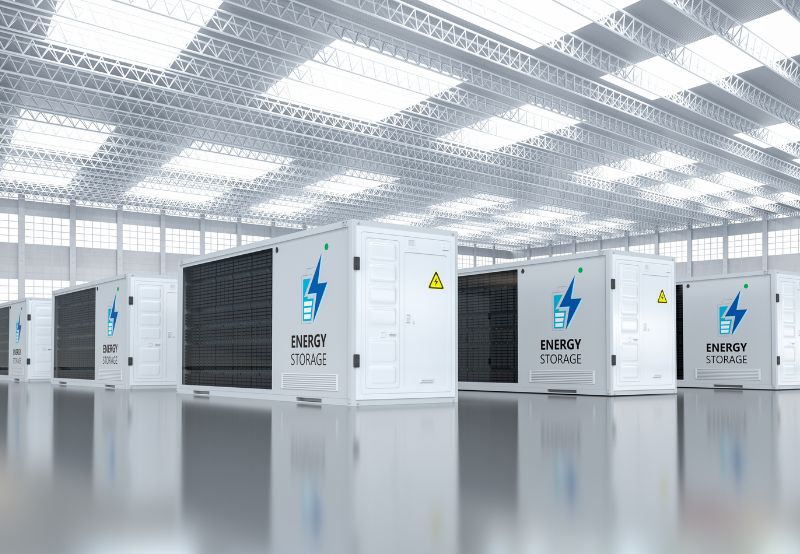
Gujarat Energy Transmission Corporation (GETCO) has invited bids to appoint a project management consultant for an automatic generation control (AGC)-enabled 5 MW/2.5 MWh battery energy storage system (BESS) pilot project in Vadodara, Gujarat.
The tender is being floated on behalf of the State Load Despatch Center (SLDC).
The project will provide grid support services to the SLDC and will be implemented under a storage-as-a-service (StaaS) model. The BESS will be designed to provide a 30-minute discharge duration.
The last date to submit bids is September 28, 2026. Bids will be opened on the same day.
Bidders must furnish an earnest money deposit of ₹40,000 (~$422) and pay a tender fee of ₹1,180 (~$12). Successful bidders must furnish a performance bank guarantee equivalent to 5% of the contract value.
The scope of work covers technical, regulatory, commercial, and implementation management services for the BESS project, from reviewing the detailed project report and preparing bidding documents to commissioning and post-commissioning monitoring.
The project must be completed within 24 months.
Selected bidders must assist GETCO and SLDC in conducting the competitive bidding process to select the BESS service provider, respond to pre-bid queries, prepare corrigenda, evaluate technical and commercial bids, and recommend the successful bidder.
They must also integrate the storage system with SLDC’s AGC and supervisory control and data acquisition systems (SCADA).
SLDC must conduct a 72-hour integrated system test before commissioning. The test will cover ramp-up and ramp-down, bi-directional dispatch, holding at set points, heartbeat-loss recovery, state-of-charge limits, and cycle-count thresholds.
The project entails issuing provisional and final commissioning certificates and monitoring the BESS for up to three months after commissioning.
The standalone BESS will be connected to GETCO’s 66 kV substation at the State Transmission Utility boundary. It will primarily provide secondary reserve ancillary services through AGC. Communication between the BESS energy management system and SLDC’s SCADA/AGC platform must be secured through a fiber-optic connection.
End-to-end latency between an AGC set point generated by SLDC and the resulting change in BESS output must be less than four seconds. If the communication heartbeat is lost for more than 12 seconds, the system must automatically ramp to zero MW.
The BESS must maintain at least 95% monthly availability. It is designed for an average of three cycles a day and a maximum of five cycles a day.
GETCO has stipulated liquidated damages of 0.5% of the contract value for every week of delay in submitting agreed deliverables, capped at 5% of the total contract value.
The pilot envisages either two 2.5 MW modular strings or a single integrated 5 MW block. Active liquid cooling of the battery cells is mandatory, considering ambient temperatures of up to 48°C in Gujarat.
Selected bidders must review these configurations and recommend the optimal design based on safety, thermal management, and reliability considerations.
In January 2026, the Grid Controller of India proposed extending AGC to large-scale renewable energy projects above 100 MW, battery energy storage systems, and pumped-storage projects.
Gujarat SLDC said the rapid growth of renewable energy has led to significant grid management challenges. Area control error at the state periphery exceeded 350 MW in nearly 30% of in-band frequency blocks, while deviation settlement mechanism penalties and renewable energy curtailment have also increased.
The SLDC also highlighted difficulties in maintaining adequate reserves.
The Gujarat government has sanctioned financial assistance to GUVNL for this project, and it will also serve as a regulatory sandbox. The operational and commercial data will help the Gujarat Electricity Regulatory Commission to develop a state-level framework for procuring ancillary services.
The project requires the power conversion systems and BESS containers to be physically separated to prevent thermal cross-contamination and ensure full-rated output across all seasons. A redundant 200 kVA auxiliary transformer, tapped from the 11 kV bus, must be established to provide auxiliary power.
SLDC/GETCO will pay the selected BESS service provider a fixed monthly capacity charge based on the availability of the contracted capacity, under the Staas model.
Bidders must have provided technical consultancy or project management services for at least one BESS project with a minimum capacity of 1 MW connected to a state or national transmission or distribution grid in India. The project must have been commissioned and be operational.
They must also have at least five years of experience in the power sector, covering at least two areas among load despatch operations, SCADA/AGC systems, grid ancillary services, renewable energy integration, and power sector regulatory advisory.
Bidders must have an average annual turnover of at least ₹6 million (~$63,330) from consultancy or advisory services during the preceding three financial years and a positive net worth as of their latest audited balance sheet.
To reduce the stress on the grid, GERC also changed the methodology for determining banking charges to a framework based on 15-minute interval injection and consumption data, power exchange prices, variable generation costs, transmission charges, and other relevant parameters. The framework will take effect on April 1, 2027.


Melvin Mathew
More articles from Melvin Mathew.