
Green Hydrogen and Storage Key to Curbing Renewables Curtailment: Interview
Hard-to-abate industries are expected to be the primary drivers of green hydrogen demand
August 3, 2026

Follow Mercom India on WhatsApp for exclusive updates on clean energy news and insights
As India rapidly expands renewable energy capacity, grid constraints are increasing the need for energy storage to support further deployment. Industry executives believe a combination of battery energy storage systems, pumped storage projects, and green hydrogen will play a critical role in reducing renewable energy curtailment, providing long-duration storage, and improving grid flexibility.
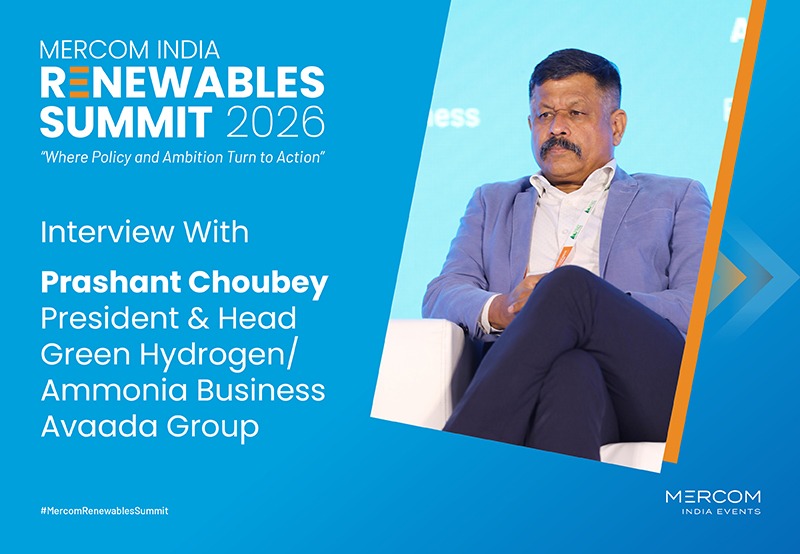
On the sidelines of the Mercom India Renewables Summit 2026, Mercom India spoke with Prashant Choubey, President and Head of Green Hydrogen and Green Ammonia business at Avaada Group, about the evolution of India’s green hydrogen market, the key demand drivers, land acquisition challenges facing independent power producers, and the emerging challenges in the ingot and wafer manufacturing segment. Avaada Group is an integrated clean energy company operating across utility-scale renewable power generation, solar manufacturing, green hydrogen, and green ammonia.
Edited excerpts from the interview:
Could you provide an overview of Avaada’s business portfolio and its operations in India?
We are a clean-energy conglomerate that started as an independent power producer. Today, we have one of the largest renewable energy portfolios among IPPs.
We have also integrated upstream into solar modules, N-type TOPCon modules, and solar cells. On the downstream side, we are developing a very large 0.5 MTPA green ammonia project in the eastern state of Odisha.
Given our capabilities in delivering round-the-clock (RTC) renewable power, data centers represent another important growth opportunity that we are currently exploring.
How has India’s green hydrogen sector evolved since the launch of the National Green Hydrogen Mission?
India has made significant progress in shaping the green hydrogen supply ecosystem after the launch of the National Green Hydrogen Mission in 2023.
Taking a cue from this, several states have also introduced highly progressive policies. The decade so far has been focused on clean energy, mostly solar and renewables, but we believe the decade to come will see a much larger role for the green hydrogen economy.
The supply side has progressed significantly. Demand and offtake remain the key challenges. However, evolving geopolitical developments, the growing project pipeline, and the emergence of a stronger ecosystem should help address offtake over time.
What are the key challenges currently facing the green hydrogen sector, and what policy support is needed to address them?
The National Green Hydrogen Mission has been one of the government’s most significant policy initiatives. It has provided policy clarity, a clear long-term direction, and production-linked incentive support for green hydrogen.
The tenders have also been issued. The Solar Energy Corporation of India’s green ammonia tender is one example. SECI has announced another 500,000-ton green methanol tender. These initiatives are helping establish the ecosystem required to scale the green hydrogen industry, and there have been positive developments in dedicated interstate transmission system service stations for green hydrogen and green ammonia.
isHow do you expect India’s green hydrogen market to develop over the next few years?
Green hydrogen has reached an important stage in its evolution.
Recent geopolitical disruptions, including tensions around the Strait of Hormuz, have reinforced the need for energy security and electrification.
There is also an immediate need for decarbonization, especially in hard-to-abate sectors where electrification may not be feasible, such as refineries, chemical plants, and fertilizer manufacturing plants.
These are all major sectors where green hydrogen will eventually play a very important role, and the shipping sector will be another major driver.
What are the major bottlenecks affecting Avaada’s independent power producer business?
India’s renewable energy sector has grown at an extraordinary pace.
India has been one of the fastest-growing renewable energy markets. If you look at the first 50 GW that came online, it took almost 11 years. The next 50 GW took almost three years. However, the last 50 GW came up in 14 months. This reflects the rapid evolution of India’s renewable energy ecosystem.
With any growing sector, there will be challenges, but challenges are part and parcel of the development story. First, transmission remains one of the sector’s biggest challenges because renewable energy projects can be commissioned much faster than transmission infrastructure. Integrated planning will therefore become increasingly important.
Second, when bidding happens, it gives a very important signal to the market. Many letters of intent (LoIs) are yet to be converted into power purchase agreements (PPAs), which the industry feels are a big challenge.
I think focus should be laid on resolving transmission-related issues and converting more LoIs into PPAs.
Land acquisition remains a significant challenge for renewable energy developers. How is Avaada addressing this issue?
Solar projects require large tracts of land, although much of it is non-agricultural or low-productivity land.
I think one important part is how you plan for the land. If it is part of the feasibility assessment you have conducted, it solves many problems.
Avaada’s approach focuses on treating local communities as key stakeholders throughout the project lifecycle. Because of the diversity of land-related policies and regulations, it is a challenge for us.
With broader, deeper engagement with communities, and transparency, land acquisition is a problem that can be solved.
Despite rapid solar capacity additions, renewable energy curtailment remains a concern. What are the primary causes, and should the solution focus on transmission expansion, energy storage, or both?
Around 150 GW of solar capacity has come up in a very short time. Most renewable energy capacity is concentrated in three or four states, and eventual impacts on the transmission system will lead to curtailment.
One solution is to diversify renewable energy deployment. Nearly 700 of India’s 720 districts receive more than 300 sunny days annually, providing significant opportunities beyond the current concentration of projects in a handful of states. Second, as more solar capacity has entered the system, the tender and bidding structures, and priorities have also shifted toward RTC renewable energy.
Procurement has increasingly shifted toward FDRE, RTC, and storage-integrated projects. Surplus daytime solar generation can be stored in batteries for evening demand, while pumped storage can absorb excess generation over longer durations.
The market is shifting from standalone solar projects to storage-integrated renewable energy solutions. At current battery prices, are such projects commercially viable at scale?
Battery storage will play an important role at a larger scale for short- to mid-term storage. Battery prices will continue to be influenced by critical mineral supply chains and India’s dependence on imported materials.
However, for long-term storage, pumped storage is very important. They will take time to come online because they have their own development and gestation periods.
A mix of battery and long-duration storage could be the solution. In the future, hydrogen could play a very important role: while batteries can store energy for hours and pumped storage can probably store it for days, hydrogen can store energy for months.
The ALMM List-II mandate has raised concerns about possible supply disruptions. How do you expect the mandate to affect the market, and how can independent power producers mitigate these risks?
ALMM has been a very important part of the policy architecture. It has played a very important role in the evolution of the solar manufacturing in India.
If India is serious about achieving self-reliance, it must move rapidly into upstream manufacturing.
The mandate of ALMM is clear: to create capability and capacity within the Indian manufacturing system. It is not merely a question of renewable energy itself but is largely related to the country’s broader energy security.
In terms of modules, I think we have seen very good capacity being established in the country. However, cells are part of a deeper ecosystem, and it takes time to establish, as it is technology- and capital-intensive and requires significant investment in infrastructure and human capital.
With the right sequencing and sustained policy focus, the industry should be well positioned by 2028.
As India moves further upstream into ingot and wafer manufacturing, what principal challenges will the industry need to overcome?
As you move from downstream to more upstream manufacturing, the requirements for capital, highly specialized chemicals and gases, and precision equipment continue to change.
Today, you are dependent on one country for 90% of polysilicon and wafers. With a target of 500 GW of renewable energy, it has a much bigger role in India’s energy security and energy sovereignty. You cannot really outsource your sovereignty and security.
Although renewable energy capacity has expanded rapidly, coal continues to meet a substantial share of peak power demand. How can renewable energy evolve to provide firmer, baseload-like power?
Storage is the critical enabler that can bring renewable energy closer to round-the-clock power. With the right combination of solar, wind, storage, and pumped-storage solution, it can be achieved. However, it will take some time to reach that level.
Storage has been a high priority for both the industry and the government. We have also seen this through tender structures such as FDRE and other mechanisms.


Melvin Mathew
More articles from Melvin Mathew.