

IEX’s Q2 Revenue Rises 8% as Electricity Trading Volumes Grow
RTM trading accounted for 41% of electricity volumes in 1H FY 2027
October 29, 2026

Follow Mercom India on WhatsApp for exclusive updates on clean energy news and insights
The Indian Energy Exchange (IEX) reported revenue of ₹1.67 billion (~$17.55 million) in the second quarter (Q2) of the financial year (FY) 2027, an 8.4% year-over-year (YoY) increase from ₹1.54 billion (~$16.18 million).
Profit after tax (PAT) rose 13% YoY to ₹1.39 billion (~$14.61 million) from ₹1.23 billion (~$12.93 million).
Earnings before interest, taxes, depreciation, and amortization (EBITDA) increased 12.6% YoY to ₹1.88 billion (~$19.76 million) from ₹1.67 billion (~$17.55 million).
Earnings per share (EPS) came in at ₹1.56 compared to ₹1.39 in the same quarter last year.
During the quarter, IEX achieved electricity trading volumes of 39.7 billion units (BU), up 12.7% YoY.
IEX said that India’s electricity demand rose 11.5% YoY to 502 BU during the quarter, driven by elevated temperatures due to El Niño and deficient monsoon rainfall.
The increase in electricity demand pushed the average Day-Ahead Market (DAM) clearing price up 46% YoY to ₹5.7 (~$0.060)/kWh. The average Real-Time Market (RTM) clearing price rose 49% YoY to ₹5.2 (~$0.055)/kWh.
First Half Results
For the first half (1H) of the financial year (FY) 2027, IEX reported consolidated revenue of ₹3.25 billion (~$34.15 million), up 9.8% YoY from ₹2.96 billion (~$31.11 million).
PAT increased 12.3% YoY to ₹2.74 billion (~$28.79 million) from ₹2.44 billion (~$25.64 million).
EBITDA rose 12.1% YoY to ₹3.72 billion (~$39.09 million) from ₹3.32 billion (~$34.89 million).
EPS came in at ₹3.08 compared to an EPS of ₹2.75 in the same period last year.
Electricity trading volumes increased 14.2% YoY to 77.2 BU.
India’s electricity demand rose 10.2% YoY to 897 BU during 1H, supported by strong industrial activity and higher irrigation demand amid a weak monsoon.
Domestic coal production declined 1% YoY to nearly 445 million metric tons during 1H.Higher summer demand strained coal inventories at power plants, while weather-related disruptions further tightened availability.
As of October 22, 2026, coal inventories at power plants were sufficient for nearly eight days, with around 100 plants holding critically low stocks equivalent to approximately three days of consumption.
Business Highlights
IEX said the RTM accounted for 41% of electricity trading volumes in 1H.
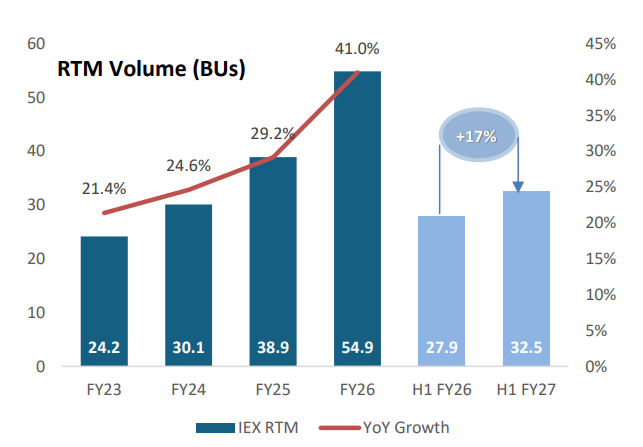
RTM volumes increased approximately 16.5% YoY to 32.5 BU from 27.9 BU.
The DAM accounted for 35% of total trading volumes, followed by the Term-Ahead Market at 14%, green markets at 7%, and certificates at 3%.
IEX said RTM’s share of electricity trading has increased from approximately 20% to 40% over the past four years, supported by a five-year compound annual growth rate of 42%.
The exchange identified increasing electricity demand, power procurement optimization, load shifting, and higher sell-side liquidity as key drivers of future trading volumes.
IEX said electricity prices declined to near-zero levels during specific daytime trading slots across approximately 26 days in Q2, creating opportunities for distribution companies (DISCOMs) and commercial and industrial consumers to replace expensive power with cheaper exchange-based procurement.
The power exchange market estimates that states optimizing their electricity procurement through exchanges could achieve cost savings of up to 10%.
Energy Storage and New Market Opportunities
During April-October, the average annualized arbitrage spread for two-hour storage systems operating on a two-cycle-per-day basis stood at ₹6.70 (~$0.070)/kWh across 270 cycles. For four-hour storage systems operating on a single-cycle-per-day basis, the spread stood at ₹6.57 (~$0.069)/kWh across 242 cycles.
IEX said approximately 22 GW of firm and dispatchable renewable energy projects have been awarded. Such tenders may also procure approximately 5% of its annual electricity requirements from green markets.
In Q1 FY 2027, IEX reported revenue from operations of ₹1.58 billion (~$16.6 million), an 11.4% YoY increase from ₹1.42 billion (~$14.92 million).


Melvin Mathew
More articles from Melvin Mathew.