

Rajasthan Notifies Thermal Compensation Rules Amid Renewable Surge
The CEA had recently recommended that thermal plants operate at minimum load levels

Follow Mercom India on WhatsApp for exclusive updates on clean energy news and insights
In a move aimed at supporting grid stability as renewable energy penetration increases, the Rajasthan Electricity Regulatory Commission (RERC) has issued a final order on compensation for part-load operation for thermal power generating stations below normative levels.
The Commission ruled that thermal generating stations whose tariffs are determined under Section 62 or Section 63 of the Electricity Act will be compensated for degradation of station heat rate and auxiliary energy consumption, and consumption of additional secondary fuel oil due to loading below the normative plant availability factor.
However, no compensation will be admissible for the generating units that fail to comply with the minimum turndown level for operation in respect of a unit of a state thermal generating station.
The state regulator added that the compensation for degradation will be borne by the entity that caused the plant to be operated at a schedule below the corresponding normative plant availability factor.
Further, the Commission directed the state load despatch center (SLDC) to submit the procedure stipulating the mechanism for calculating compensation within 30 days of the issuance of the order.
In February, a committee constituted by the Central Electricity Authority (CEA) called for operating thermal power plants at a minimum technical load (MTL) of 40% and adopting two-shift operations to support grid stability amid increasing renewable energy integration. In a draft report on the wear and tear, operations and maintenance, and plant lifespan implications of thermal plants due to flexible operations, the committee concluded that operating thermal plants at 55% MTL had not resulted in any significant damage attributable solely to flexible operation.
Background
The Commission initiated the proceedings to develop a framework for compensating thermal generators when they are required to operate below their normative load levels.
Such operations lead to higher coal consumption, increased oil support, higher auxiliary consumption, reduced efficiency, and increased maintenance costs.
A draft order was issued, and public comments were invited.
Suggestions were received from stakeholders, including Rajasthan Rajya Vidyut Utpadan Nigam (RRVUNL), Adani Power, Rajasthan Urja Vikas Nigam (RUVNL), JSW Energy (Barmer), and individual stakeholders.
During the consultation process, stakeholders raised several concerns. They said that the proposed regulations clearly indicate that Rajasthan has sufficient, and at times surplus, renewable energy availability during specific time blocks. In such circumstances, rather than shutting down state-owned thermal generating units, it would be prudent to operate them at their technical minimum levels to facilitate the absorption of low-cost renewable energy, while keeping as many units as possible in hot standby to address system contingencies.
Some stakeholders argued that the compensation mechanism should be made retrospective from January 29, 2025, the date of notification of the Rajasthan Electricity Grid Code, 2024.
They also contended that the heat-rate degradation values proposed in the draft order were lower than those recommended by the CEA, particularly at lower unit loading levels, where efficiency loss is higher. They suggested aligning the compensation levels with CEA recommendations.
They argued that the norms for secondary fuel oil consumption during start-ups were insufficient compared to actual operational requirements. They requested a revision of the norms.
Some stakeholders opposed Clause 7 of the draft order, which proposed sharing financial gains from part-load compensation between generators and beneficiaries on a 1:1 basis.
Commission’s Analysis
The Commission noted that the thermal generating stations will be compensated for the degradation of station heat rate and auxiliary energy consumption, as well as for the consumption of additional secondary fuel oil due to loading below the normative plant availability factor.
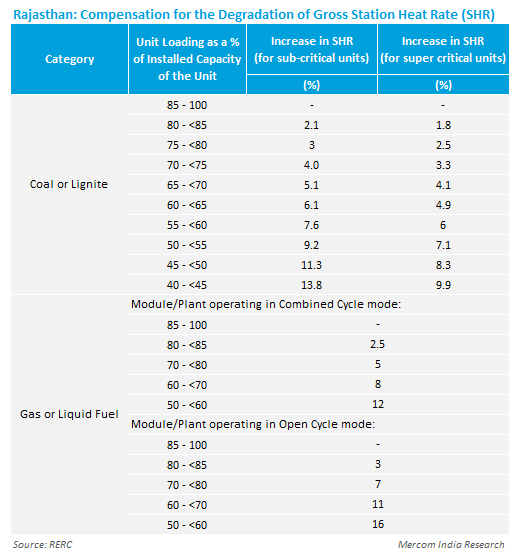
For compensation of the degradation of gross station heat rate over and above the norms specified under the 2025 regulations, or the contract, as the case may be, will be considered as under:
 Compensation for the Degradation of Auxiliary Energy Consumption
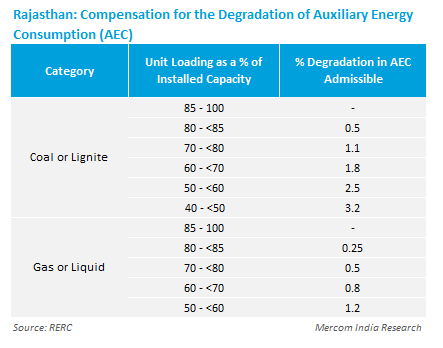
Regarding compensation for the degradation of auxiliary energy consumption (AEC) over and above the norms specified under 2025 regulations or the contract, as the case may be, will be considered as follows:
 RERC addressed the issues raised during the consultation.
Units Below 200 MW
The Commission accepted the request to include units below 200 MW for oil consumption compensation and directed SLDC to incorporate a dispute-resolution mechanism into the detailed procedure.
Implementation Date
The state regulator rejected the proposal for retrospective implementation, noting that compensation generally should not be applied retrospectively. The effective date will be specified in the procedure to be issued by the SLDC with the Commission’s approval.
The Commission decided to retain the clause denying compensation to units that fail to comply with minimum turndown levels, stating that it ensures compliance with operational requirements.
The regulator rejected the request to delete the financial gains sharing clause, stating that the provision is aligned with the CERC Tariff Regulations (First Amendment), 2025, and therefore will remain in the order.
On the issue of annual reconciliation, RERC stated that detailed procedures for computation and settlement will be specified by SLDC.
It accepted the request for a defined timeline and directed SLDC to submit the detailed procedure within 30 days of the order.
In January this year, RERC issued the draft Demand Flexibility/Demand Side Management Regulations, 2026, proposing a comprehensive regulatory framework to integrate demand-side resources into the state’s power system.
Last November, RERC rejected a petition by the state-owned power trading company to procure 3.2 GW of coal-fired thermal power, saying the proposal is inconsistent with the state’s renewable energy policy framework.
Subscribe to Mercom’s real-time Regulatory Updates to ensure you don’t miss any critical updates from the renewable industry.


Rakesh Ranjan
More articles from Rakesh Ranjan.