

US Adds Record 9.7 GWh of Energy Storage Capacity in Q1 2026: Report
The SEIA-BMI report forecasts 610 GWh of cumulative energy storage capacity by 2030
May 21, 2026

Follow Mercom India on WhatsApp for exclusive updates on clean energy news and insights
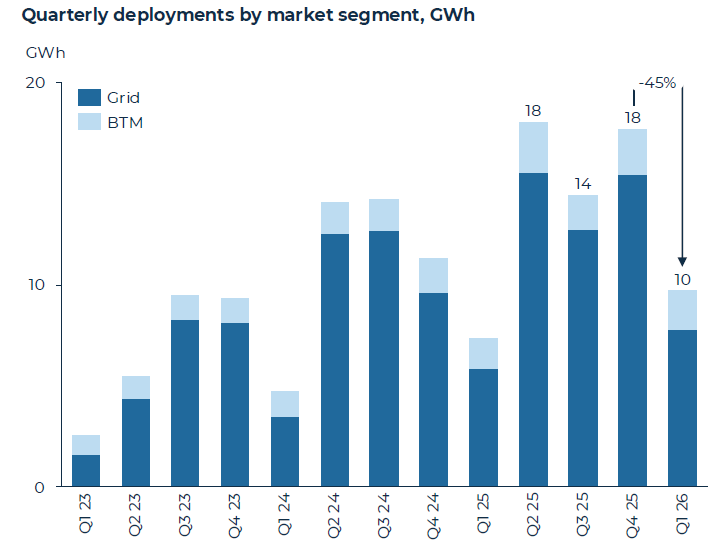
Despite policies disincentivizing clean energy growth, the U.S. added a record 9.7 GWh of energy storage capacity in the first quarter (Q1) of 2026, up 32% year-over-year (YoY), according to a joint report by Solar Energy Industries Association (SEIA) and Benchmark Mineral Intelligence.
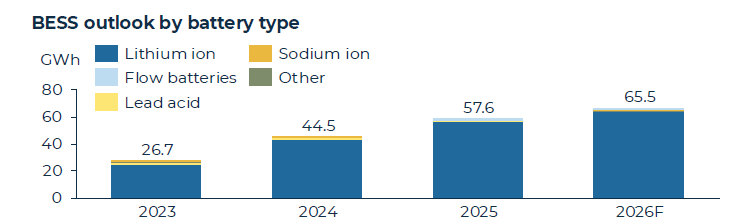
By 2030, the market is expected to exceed an annual installation capacity of 110 GWh and reach a cumulative installation capacity of 613 GWh.
The utility-scale market accounted for over 75% of deployments in Q1 2026, as developers continue to see growing opportunities in capacity markets, energy arbitrage, and long-term contracts. In Q1 2026, standalone utility-scale energy storage projects accounted for 62% of additions, while solar-plus-storage solutions made up the remaining 38%.
The report noted that as investors, developers, and grid operators respond to energy price volatility driven by disruptions in global gas and gas turbine supplies, solar and storage have become increasingly attractive.
According to a report by Wood Mackenzie, the U.S. installed a record 18.9 GW/51 GWh of energy storage in 2025, increasing 52% YoY.
Utility-Scale Energy Storage
In Q1, installed utility-scale storage in the U.S. stood at 7.8 GWh.
Texas, Arizona, and California led the nation in utility-scale energy storage capacity in Q1, maintaining their positions as the three largest energy storage markets in the U.S.
Notably, 71% of all utility-scale energy storage capacity installed in Q1 was built in states that President Donald Trump won.
Thirteen states now have explicit energy storage targets, helping drive continued investment and deployment. States such as Georgia, Iowa, and Mississippi also posted notable gains in installed storage capacity during the quarter.
Residential Segment
Residential energy storage deployments decreased by 28% YoY to 515 MWh across the U.S.
This initial contraction is likely to continue as the market adjusts to the end of the 25D tax credit. The report explained that some projects originally scheduled for Q1 2026 may have been pulled forward to Q4 2025 to take advantage of the expiring tax credit.
However, given the ongoing energy shock across international markets, it said electricity prices are rising again, improving the outlook for residential batteries due to stronger economics.
The report highlighted that the removal of tax credits and incentive programs often leads to sharp but temporary declines in deployments. Looking ahead, the residential storage market is expected to continue recovering through 2030.
Meanwhile, BTM-market deployments fell to 1.91 GWh, largely due to a 35% quarter-over-quarter decline in residential deployments to 515 MWh. The C&I segment also declined, adding 648 MWh.
The BTM segment’s market share is expected to increase to 20% by 2030.
Data Centers Drive Demand
The report stated that data centers are driving demand growth for energy storage solutions, with Google, Meta, and other technology companies announcing deals to procure tens of thousands of MWh of energy storage so far this year.
However, the report warned that if federal permitting bottlenecks persist, household electricity bills will continue to rise, and China could move further ahead in the race for artificial intelligence leadership.
According to the SEIA, 467 solar and storage projects have permits pending and are vulnerable to politically motivated delays or cancellations.
Data center growth in the U.S. led facility developers to adopt a variety of energy storage approaches. In addition to previously seen lithium iron phosphate battery energy storage system deployments for peak shaving, Google and Meta are deploying ultra-long-duration energy storage to secure 24/7 carbon-free power for their data centers.
Google announced plans to install a 30 GWh iron-air system in Minnesota in partnership with Form Energy. At the same time, Meta has reserved up to 100 GWh of capacity using Noon Energy’s reversible solid oxide fuel cell technology. These systems provide more than 100 hours of discharge, enabling facilities to maintain critical uptime during multiday renewable energy lulls.
Other data centers are expected to continue using a multi-stage battery approach, with lithium-ion systems deployed outside the facility for peak shaving and high-power uninterruptible power supply systems used inside data centers to manage load swings.
As per the report, many electric vehicle factories are retooling production lines to serve the energy storage market, and the U.S. could reach over 120 GWh of battery cell manufacturing capacity if all these facilities come online as planned.
According to the International Renewable Energy Agency, firm-levelized cost of energy for solar plus storage solutions fell to $54-82/MWh by 2025 in high-irradiance solar regions and strong wind corridors globally from over $100/MWh in 2020.


Melvin Mathew
More articles from Melvin Mathew.