

Varun Beverages Hopes to Cut Power Bill by ₹60 Million with Rooftop Solar
The 5.5 MW solar project is expected to meet 20% of the manufacturing unit’s power needs

Follow Mercom India on WhatsApp for exclusive updates on clean energy news and insights
As commercial and industrial companies explore clean energy options to offset rising energy costs and meet their sustainability commitments, on-site rooftop solar solutions have emerged as a viable solution.
For large-scale manufacturers, electricity is a critical input that affects production costs, particularly at facilities where refrigeration, bottling lines, packaging equipment, and round-the-clock operations demand substantial power.
Understanding how an insufficient power supply can hamper production lines, companies are leveraging solar rooftop solutions to not just slash grid power costs but meet fluctuating power requirements.
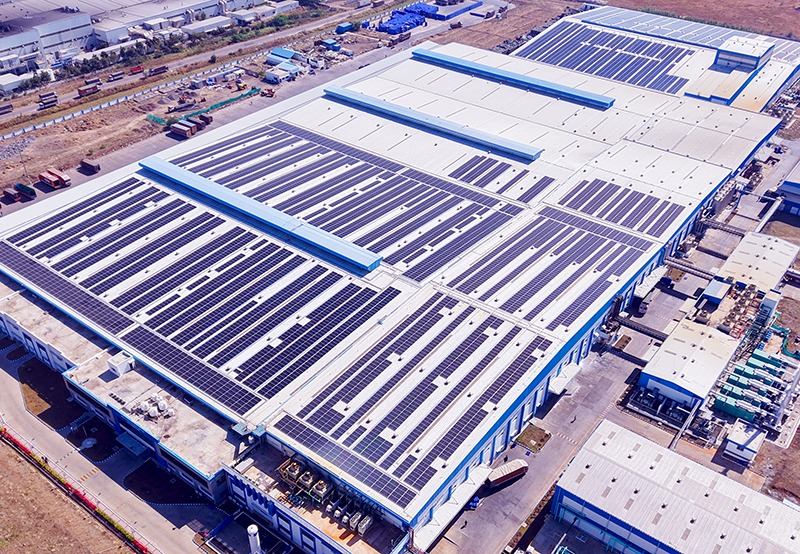
In April 2026, Haryana-based Varun Beverages (VBL) commissioned a 5.5 MW rooftop solar power system at its Supa manufacturing facility in Parner, Maharashtra and is now looking to reduce its electricity expenditure by an estimated ₹60 million (~$629,000) annually.
The project is expected to generate approximately 7.5 GW electricity annually and will meet around 20% of the facility’s total electricity requirements. The company has estimated monthly savings of up to ₹5.5 million (~$58,000), with every unit of solar electricity offsetting grid power priced at approximately ₹8.30 (~$0.087)/kWh.
The Supa facility consumes approximately 37.7 million units of electricity annually and operates with a contracted demand of 9,990 kVA. Electricity consumption at the facility varies significantly throughout the year, ranging from about 1.7 million units during lean production months to nearly 4 million units during peak production months.
Developed by Delhi-based Vibgyor Energy, the solar project was designed based on an analysis of 12 months of consumption data to accurately match the facility’s seasonal load profile and avoid over- or undersizing.
The rooftop installation consists of 9,322 RenewSys solar modules rated at 590 W each and 32 Sungrow SG125CX-P2 string inverters.
Ishaan Gadhoke, Executive Director at Vibgyor Energy, said that the use of string inverter architecture enables granular maximum power point tracking and string-level monitoring across multiple rooftop sections, improving energy generation and fault detection capabilities.
The project spans multiple rooftops across the main facility and other buildings, each with different structural characteristics, orientations, and rooftop obstacles.
The company conducted roof-by-roof structural and load assessments, customized mounting layouts and string configurations for each section. The design also incorporated shadow analysis, maintenance walkways, and safety provisions while ensuring all structures remained within permissible load limits.
“As the entire output is self-consumed, every solar unit offsets grid power at the full applicable tariff,” Gadhoke said. The project provides a long-term hedge against electricity tariff escalation while improving the beverage manufacturer’s energy cost predictability, the company added
Talking about the regulatory challenges during the implementation phase, Vibgyor Energy stated that the project was among the early large commercial and industrial rooftop installations established under the Maharashtra Electricity Regulatory Commission’s (MERC) Net Billing Regulations, 2023. The company worked with the utility and represented the matter before MERC to ensure that the billing treatment aligned with regulatory provisions and protected the project’s intended savings.
Mohit Gupta, Manager – ESG at Varun Beverages, said the project was driven by both cost reduction and sustainability objectives. “On-site rooftop solar advances this directly: it lowers our energy cost, strengthens the reliability and predictability of our power, and cuts our Scope 2 emissions by generating clean power on our own roofs, exactly where we consume it.”
The project currently operates at an average performance ratio of around 80%, with generation reaching approximately 93% of design estimates and a capacity utilization factor of about 20%.
“The system was designed and integrated around our operations, so commissioning did not disrupt production, and the plant has been delivering the generation and savings we expected from the outset,” Gupta added.
Varun Beverages stated that it is evaluating opportunities to expand its adoption of renewable energy across its facilities as part of its long-term sustainability roadmap and its commitment to achieving net-zero greenhouse gas emissions by 2050.
Last September, Varun Beverages signed a power purchase agreement with Vibgyor Energy for a 22.5 MW solar project integrated with a battery energy storage system in Rajasthan.
Mercom India organizes C&I Clean Energy Meets across the country to connect solar developers with commercial and industrial businesses looking to adopt clean energy solutions on a common platform.
The next event in the series will be held in Hyderabad on August 21, 2026.


Meghana Prasad
More articles from Meghana Prasad.