

China’s Solar Capacity Reaches 1.29 TW in July, Up 16% YoY
The country added 86.15 GW of solar capacity between January and July

Follow Mercom India on WhatsApp for exclusive updates on clean energy news and insights
China’s installed solar power capacity reached 1.29 TW at the end of July 2026, up 16.1% year-over-year (YoY), according to the latest electricity statistics released by the National Energy Administration (NEA).
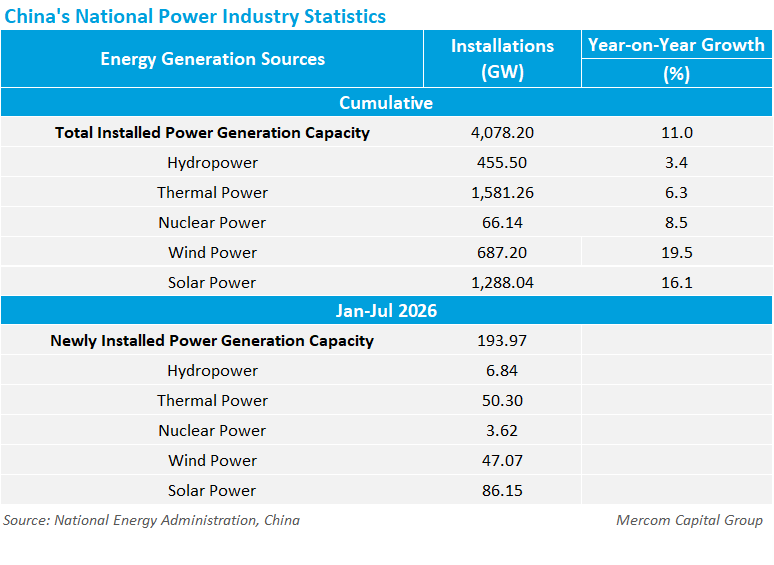
The country’s wind power capacity stood at 687.20 GW, up 19.5% YoY, while its hydropower capacity reached 455.50 GW, thermal power 1.58 TW, and nuclear power 66.14 GW.
China’s total installed power generation capacity reached 4.08 TW as of July, up 11% YoY.
The national average utilization hours of power generation equipment stood at 1,671 hours during January-July 2026, down 135 hours from the same period last year.
Between January and July, total installed power generation capacity reached 193.97 GW. Solar accounted for the largest share of new capacity additions at 86.15 GW, down 139.22 GW from the same period last year, followed by 50.30 GW of thermal power.
Wind capacity additions stood at 47.07 GW, hydropower at 6.84 GW, and nuclear power at 3.62 GW.
China has set a target to increase its total renewable energy generation capacity to around 3.5 TW by 2030 under its Renewable Energy Development Plan for the 15th Five-Year Plan period.
It aims to take its annual renewable energy generation to approximately 6,000 TWh by 2030. The country’s wind and solar capacity are expected to exceed 2.8 TW, accounting for more than 50% of the country’s total installed power generation capacity.
The plan also targets total renewable energy consumption of around 1.8 billion tons of standard coal equivalent by 2030.
In the first half of 2026, China added 158.7 GW of new power generation capacity.
In June, NEA issued measures to set minimum targets for renewable energy consumption in critical energy-intensive industries and assign responsibility weights for renewable power consumption to provincial-level administrative regions. The measures took effect on August 1, 2026.
To limit the buildout of low-efficiency solar modules, China has rolled out new minimum efficiency standards for components across the solar manufacturing value chain, covering polysilicon, wafers, modules, and inverters. The standards will take effect on January 1, 2027. For TOPCon and HJT modules, the minimum efficiency is set at 23.2%. The minimum efficiency standard for back-contact solar modules is 23.5%.


Melvin Mathew
More articles from Melvin Mathew.