

Food Processing Plant Switches to Solar, Expects Payback in 3 Years
The company’s 3 MW solar project meets up to 50% of its monthly power needs

Follow Mercom India on WhatsApp for exclusive updates on clean energy news and insights
Switching to solar energy is a viable proposition for industries that must operate around the clock and are in states with high grid tariffs.
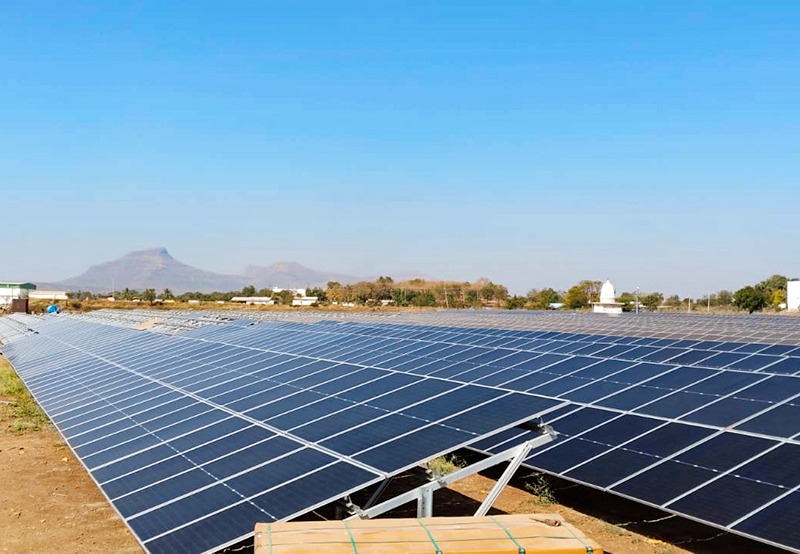
S & P Feeds, a part of Anand Agro Group, a food processing plant in Nashik, Maharashtra, turned to solar to cut its electricity expenses. It installed a 3 MW ground-mounted solar project in March 2025 that today meets 40–50% of its monthly power consumption.
The company turns corn into poultry feed and produces soy meal and oil by processing soybeans. Solar power is used to power both of these processes. While the feed processing plant uses 1.4 MW, the soya bean processing facility uses 1.6 MW.
Uddhav Ahire, CMD, S & P Feeds, said that power is largely used for captive consumption in its 500-ton-per-day poultry feed manufacturing plant and the 300-ton soya bean processing plant.
The company said it chose a ground-mounted setup over a rooftop one due to insufficient rooftop space. S & P Feeds has 35 acres of land, and the ground-mounted solar project occupies 9 acres.
B. U. Bhandari Energy set up the project at the cost of ₹105 million (~$1.16 million).
The solar installation utilizes Navitas Solar’s 550 Wp Mono PERC bifacial modules and 7 units of Sungrow ’s 320 kW inverters.
The solar system generates 10,000 to 11,000 units of power daily and 315,000 to 350,000 units monthly.
The project is expected to yield payback within three years.
Through the project, S & P Feeds saves between ₹2.8 million (~$30,924) and ₹3 million (~$33,134) per month.
Before the project’s installation, S & P Feeds’ monthly electricity expenditure stood at ₹8.8 million (~$97,188).
Ahire said the company has been trying to meet its power needs through renewable sources, such as biogas, and that solar was an addition to its procurement portfolio.
However, he added that one of the biggest drivers for C&I units in Maharashtra to opt for solar is the high tariff for industrial consumers, which is around ₹11 (~$0.122)/kWh.
He also expressed concerns about the changing solar policy landscape in Maharashtra, noting that the Maharashtra State Electricity Distribution Company had proposed limiting the use of banked solar power to solar hours alone.
Ahire said that while the proposal is on hold, if implemented, it could increase the project’s return on investment from three to four years to around six years.
The company said it plans a new hatchery and 1.3 MW solar projects for it. It will comprise 70% rooftop and 30% ground-mounted solar.
Mercom India hosts a pan-India ‘C&I Clean Energy Meet’ series, bringing renewable energy developers and commercial and industrial power consumers together to discuss options for adopting renewable energy. The next event will be held in Bhopal on March 13, 2026.


Melvin Mathew
More articles from Melvin Mathew.