

LEAPTING Crosses 10 GW Milestone in India as Solar Cleaning Robot Demand Grows
The company showcased its new G1 Plus robotic cleaning system at REI Expo 2026
November 2, 2026

Follow Mercom India on WhatsApp for exclusive updates on clean energy news and insights
Solar cleaning robot manufacturer LEAPTING has crossed the 10 GW milestone in India, supplying more than 50,000 robots to solar developers and engineering, procurement, and construction (EPC) contractors.
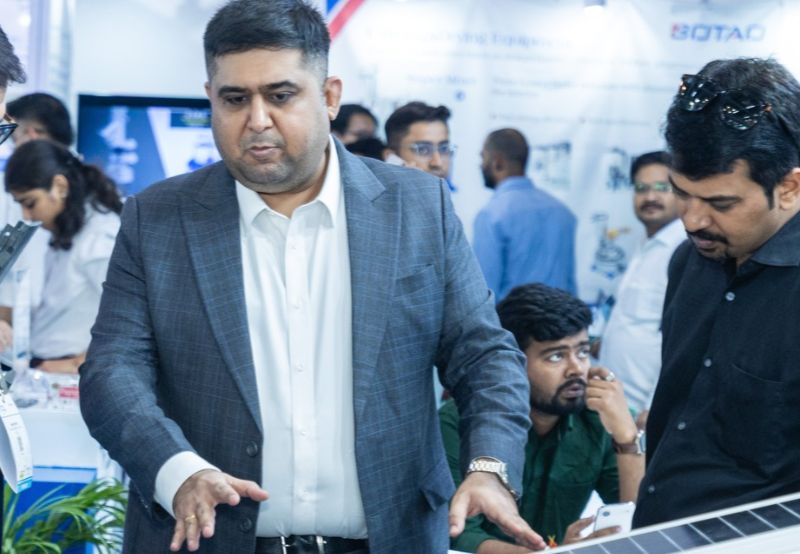
At the recently concluded Renewable Energy India (REI) Expo 2026 in Greater Noida, the company showcased its G1 Plus Intelligent Solar Cleaning Robot, designed to improve cleaning efficiency and compatibility with solar tracking systems.
In an interview with Mercom India, Gaurav Gaba, Head of India Sales at LEAPTING, discussed the growing adoption of waterless robotic cleaning, the challenges of managing soiling losses at utility-scale solar projects, and the company’s plans to expand its presence in India.
What are the key features of the newly launched G1 Plus Intelligent Solar Cleaning Robot, and how does it differ from the earlier G1 model?
The G1 Plus incorporates several improvements over our earlier G1 model. We have redesigned the brush to increase its density and introduced brushless direct current (BLDC) motors. We have also modified the structural design and reduced the robot’s weight.
The 1P (one-module portrait) variant weighs approximately 45 kg, while the 2P (two-module portrait) variant weighs around 55 kg. The 1P variant is primarily designed for solar tracking systems and is compatible with leading tracker manufacturers. The 2P variant is mainly used in fixed-tilt installations. The size of the robot and the number of motors increase in the 2P configuration.
Another key feature of the G1 Plus is its ability to twist up to 25 degrees, letting it navigate obstacles, bridges, and gaps in tracker-based installations.
The G1 Plus uses high-density polybutylene terephthalate (PBT) brushes to remove accumulated dust from solar modules without requiring water.
The robot is fully integrated with supervisory control and data acquisition (SCADA) systems. Operators can initiate cleaning cycles through SCADA after solar generation hours.
A daily cleaning cycle is sufficient for routine dust removal. The system also supports automated reporting, allowing operators to monitor cleaning activities.
What are the major cleaning and O&M challenges facing utility-scale solar projects in India?
Dust accumulation is one of the biggest challenges for solar developers in India. It causes significant soiling losses, reducing electricity generation and affecting the overall project economics and internal rate of return (IRR).
Another major challenge is reliable after-sales service. Solar cleaning robots are long-term operations and maintenance (O&M) products, and developers need assurance that technical support and spare parts will be available throughout the project’s operational life.
We have more than 100 people providing after-sales services in India, a dedicated O&M center in Agra, and multiple warehouses across the country to support our customers.
How is the Indian market for robotic solar cleaning systems evolving?
The Indian utility-scale solar market is rapidly shifting toward fully automated dry-cleaning systems.
Water scarcity is a key driver of this transition. Developers are also increasingly considering environmental, social, and governance (ESG) requirements when selecting cleaning technologies.
We are seeing strong adoption of robotic dry-cleaning systems across utility-scale solar projects. Developers recognize the importance of reducing water consumption while maintaining module cleanliness and minimizing generation losses.
How cost-effective are robotic cleaning systems compared with conventional wet cleaning?
Robotic dry cleaning is highly cost-effective when the reduction in soiling losses is considered. The comparison should not be limited to the initial investment. Developers must also consider lost electricity generation due to dust accumulation and the operational expenses of conventional cleaning.
Automated dry cleaning enables regular cleaning, which helps minimize soiling losses and improve the overall economics of solar projects.
How are LEAPTING’s robots performing in challenging climatic conditions, particularly in states such as Rajasthan and Gujarat?
Our robots are designed to operate in challenging climatic conditions, including hot, dry, and humid environments. We have installations operating in India under these conditions. Our oldest installation in the country has been operational for more than three years without significant weather-related issues.
How has the adoption of LEAPTING’s cleaning robots progressed in India?
We have recently crossed the 10 GW milestone in India and supplied more than 50,000 cleaning robots. We are receiving strong demand from Indian customers and working with leading solar developers and EPC contractors.
The increasing adoption of automated cleaning solutions reflects the industry’s growing focus on reducing soiling losses and improving the operational efficiency of utility-scale solar projects.
How does fully automated robotic cleaning compare with manual or semi-automated cleaning systems?
A major challenge with manual and semi-automated cleaning is that workers must move equipment from one module row to another. This increases labor costs and raises the risk of component damage during handling, especially when workers are not adequately trained.
With fully automated robots, equipment is installed once and operates without requiring workers to move it repeatedly between rows. The cleaning process, operational commands, and reporting are integrated with SCADA. This reduces the need for manual intervention during regular operations.
What is the expected operational life of LEAPTING’s robots, and what warranty and maintenance support does the company provide?
Our robots come with a standard two-year warranty. After the warranty period, customers can opt for a comprehensive annual maintenance contract (AMC) extending up to 23 years.
The AMC covers parts and maintenance, providing long-term support for customers’ robotic cleaning systems.
What are LEAPTING’s expansion plans in India?
We will continue promoting both the G1 and G1 Plus models based on customer requirements. For 2P fixed-tilt projects, the G1 remains a suitable option. For 1P tracker-based projects, the G1 Plus offers additional advantages because it can twist up to 25 degrees and navigate gaps and obstacles.
Our primary customers are independent power producers (IPPs) and EPC contractors developing large utility-scale solar projects. We are focused on securing more projects from these customers and expanding our presence in the Indian market.


Rakesh Ranjan
More articles from Rakesh Ranjan.