

LEAPTING Eyes Expansion in India as Solar Cleaning Robots Gain Ground
The company has commissioned cleaning robots across 10 GW of solar projects in India
October 29, 2026

Follow Mercom India on WhatsApp for exclusive updates on clean energy news and insights
As India’s utility-scale solar installations expand, developers are increasingly adopting robotic cleaning systems to cut water use, increase cleaning frequency, and manage operations and maintenance (O&M) costs.
Solar robotics company LEAPTING has commissioned cleaning robots across approximately 10 GW of utility-scale solar projects in India and signed contracts covering nearly 16 GW.
India accounts for approximately 95% of the company’s global solar cleaning business revenue, making it its largest market.
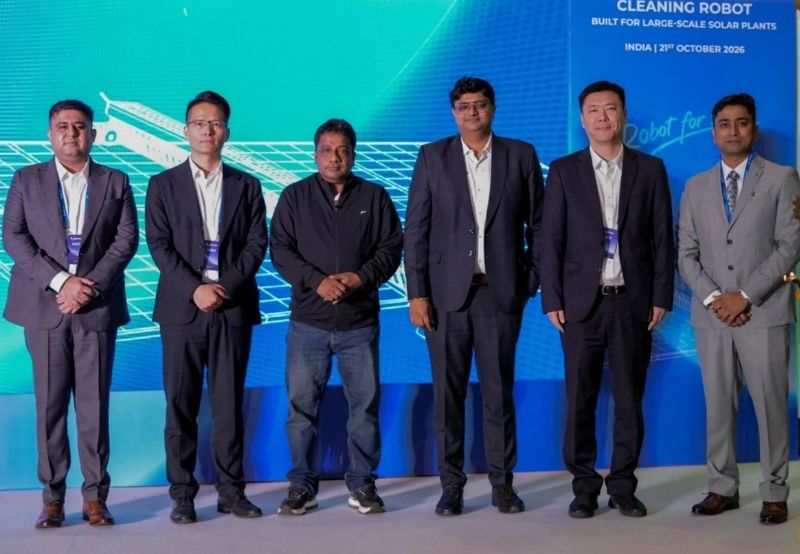
The company recently launched its next-generation G1 Plus intelligent solar cleaning robot in India ahead of the Renewable Energy India (REI) Expo 2026. The new system improves cleaning performance, motor technology, and compatibility with solar tracker structures.
LEAPTING is also looking beyond module cleaning to develop robotic solutions for module installation, inspection, material handling, and other construction activities.
In an exclusive interview with Mercom India, Vincent Liu, Director of Global Sales at LEAPTING, discussed the company’s expansion plans, the increasing adoption of robotic cleaning systems in India, technological developments, and the challenges of providing long-term maintenance support for solar automation equipment.
Why did LEAPTING choose India to launch its G1 Plus intelligent solar cleaning robot? What major technological improvements does it offer over the previous generation?
India has been our starting market since LEAPTING was established in 2022, and it remains our most important market.
The G1 Plus incorporates improvements based on our experience supplying cleaning robots for more than 10 GW of solar projects.
One major improvement is its compatibility with solar trackers. In real-world project conditions, tracker tables aren’t always perfectly aligned, and their angles and heights can vary. The new robot can accommodate greater differences between tables, improving its ability to operate across these structures.
We have also improved brush density and cleaning performance. Another important development is the introduction of upgraded brushless motors, which are designed to improve operational stability, extend motor life, and enhance compatibility with tracker structures.
The G1 Plus is compatible with both single-axis trackers and fixed-tilt mounting structures.
LEAPTING has commissioned cleaning robots across 10 GW of solar projects in India. What are its expansion plans?
We have commissioned cleaning robots across about 10 GW of solar projects in India, while our signed contracts cover nearly 16 GW.
However, delivering the robots is only the first step. What matters more is ensuring they operate reliably throughout the project’s life.
Solar projects are designed to operate for 25 to 30 years, and customers expect cleaning systems to support them over the long term. This makes maintenance services and long-term customer relationships extremely important. We are focusing on annual maintenance contracts and strengthening our O&M capabilities.
India accounts for nearly 95% of our solar cleaning business revenue. We are also studying opportunities to localize cleaning robot manufacturing in India.
What factors are driving the adoption of robotic solar cleaning systems in India, particularly when labor costs remain relatively low compared with other markets?
Although labor costs in India are relatively low, cleaning large utility-scale solar projects manually presents several challenges.
These projects have enormous numbers of solar modules, and organizing workers, vehicles, cleaning equipment, and water supplies across such large installations can be difficult.
Water availability is another important consideration, particularly in regions where large solar projects are located. Some solar modules also require purified water for cleaning, which adds to the operational requirements.
Manual cleaning may be carried out once every 15 days, depending on the project’s resources and operating arrangements. Robotic cleaning systems can operate daily, allowing modules to be cleaned more frequently.
Our robots have solar charging panels and can operate automatically on programmed schedules.
How important is long-term O&M support for solar cleaning robots, and what challenges does the industry face in ensuring reliable performance?
The solar cleaning robotics market is developing, but it has not yet reached full maturity.
Earlier, customers were primarily concerned with whether cleaning robots were reliable and whether they needed them. Now, they are increasingly concerned about maintenance support, service response times, and whether suppliers will remain in business over the long term.
Customers are also evaluating third-party O&M providers that can maintain cleaning robots from different manufacturers to optimize costs.
This is becoming an important consideration because solar projects have operating lifespans of 25 to 30 years.
If a cleaning robot manufacturer exits the market or stops providing support, project owners could struggle to maintain their equipment. Replacing entire cleaning systems can also be expensive.
India and the Middle East markets represent more than 150 GW of projects using cleaning robots.
What are the G1 Plus’s main features, and how does its cleaning performance vary across different solar mounting configurations?
The G1 Plus is available for different module mounting arrangements, including 1P and 2P configurations.
A 1P configuration generally refers to a single portrait-oriented module arrangement, commonly used with single-axis trackers. A 2P configuration has two portrait-oriented modules and is commonly associated with fixed-tilt structures, although some tracker projects also use this arrangement.
The G1 Plus has a stated cleaning speed of 16 to 22 meters per minute. However, actual cleaning capacity depends on several factors, including module row length and battery capacity.
We offer different battery configurations depending on project requirements. Smaller battery configurations suit shorter rows, while additional battery capacity supports longer operating distances.
For example, a 1P robot can cover about 1.5 km of travel, corresponding to roughly 1 MW of modules per row. A 2P configuration can cover approximately 2 MW over a similar distance.
The robot uses motorized wheels for movement and a rotating brush to remove accumulated dust.
A key feature of the G1 Plus is its ability to accommodate differences in alignment between adjacent module tables. Its structure can twist as it moves between tables, allowing it to handle situations where one side moves upward while the other moves downward.
Once the robot is scheduled and connected to the control system, it can clean without an operator present. The system also reports faults to a central control platform, allowing authorized personnel to monitor equipment availability and identify operational problems remotely.
Beyond cleaning, how does LEAPTING plan to expand the use of robotics across the solar project life cycle?
Our long-term objective is to introduce robotics across different stages of a solar power project’s life cycle, rather than focusing exclusively on module cleaning.
During project construction, we are developing robotic solutions for module installation and material handling, including installation robots and forklift robots.
We are also developing module inspection robots that can identify issues such as abnormal module temperatures and potential hot spots.
Looking further ahead, we see opportunities for robots involved in fastening, tracker piling, and torque tube installation.
For solar project operations, we are developing additional cleaning solutions suited to different operating environments.
For example, the G1 Plus is designed primarily for dry cleaning. However, certain locations experience sticky dust that accumulates rapidly, and conventional dry cleaning cannot always remove it effectively.
For these applications, we are developing an automated guided vehicle (AGV) cleaning solution, internally referred to as G2, which can perform wet cleaning.
Such systems could also be relevant in markets where cleaning is required less frequently, including parts of Europe. We expect some of these additional robotic technologies to enter the Indian market over the next two to three years.
However, installation and forklift robots may take longer, potentially around five years, before wider introduction. Our immediate priority is to strengthen our cleaning robotics business, develop long-term service capabilities, and explore localization opportunities in India.


Rakesh Ranjan
More articles from Rakesh Ranjan.