

Manufacturers Expect Solar Cell Crunch to Not Last Beyond a Year
Module manufacturers are moving toward vertical integration
July 8, 2026

Follow Mercom India on WhatsApp for exclusive updates on clean energy news and insights
The renewable energy industry believes there will be a shortage of solar cells over the next 12 months due to the ALMM List-II mandate, but strong domestic demand, policy support, and increasing backward integration will help stabilize the sector.
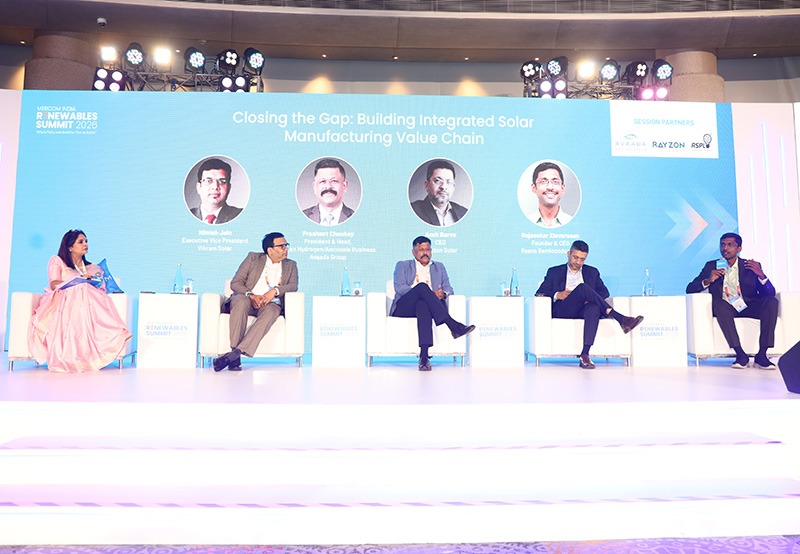
At a panel discussion “Closing the Gap: Building Integrated Solar Manufacturing Value Chain” at the Mercom India Renewables Summit 2026, panelists said the current supply chain imbalance should be viewed as a short-term transition rather than a structural problem.
The discussion was moderated by Priya Sanjay, Managing Director, Mercom India.
Nimish Jain, Executive Vice President at Vikram Solar, said solar module manufacturers are using this phase to move toward vertical integration, with many companies investing in solar cells, wafers, and eventually ingot manufacturing.
He felt that the ALMM mandate will filter out non-serious players. Export opportunities will open for those who consolidate their operations.
Amit Barve, CEO at Rayzon Solar, said that the manufacturing gap is evident, but seasonal demand patterns are helping moderate the short-term impact of limited domestic cell availability.
He noted that the second and third quarters traditionally witness lower solar installations, reducing immediate pressure on cell supplies. Many manufacturers have planned inventories and project pipelines that will help them navigate the evolving landscape over the next few months.
Barve also pointed out that the shortage is more pronounced for TOPCon cells, while mono PERC capacity remains available.
Panelists said that manufacturers are encouraging customers to remain technology-neutral where project economics permit, adding that market acceptance of alternative technologies has improved.
Cell Manufacturing Challenges
As India moves to comply with the ALMM-II mandate and ramps up cell manufacturing capacity, manufacturers point out that the transition will not be as smooth as building solar module capacity has been.
Prashant Choubey, President and Head of the green hydrogen/ammonia business at Avaada Group, said that while module assembly was relatively straightforward, cell manufacturing requires significantly greater capital, technical expertise, specialized chemicals, gases, precision equipment, and long-term patient investment. “Cell manufacturing is capital-intensive, precision-intensive, and technology-intensive.”
Jain said that module manufacturing generally operates at 80% to 85% capacity utilization to remain competitive, while demand-side utilization for solar cells may exceed 90% over the next 12 to 18 months, although production ramp-up and stabilization will initially limit actual output.
Barve said technical manpower remains the single biggest obstacle facing India’s cell manufacturing expansion.
He estimated that establishing a solar cell manufacturing facility currently takes 18 to 24 months, compared with approximately 3 to 4 months for module manufacturing.
He attributed the longer timeline to installation complexity, commissioning, equipment optimization, and shortages of trained technical personnel.
Panelists said that while equipment suppliers provide standard operating parameters, Indian manufacturers must develop their own expertise to continuously improve efficiency, product quality, and manufacturing yields through research and development, a process that requires skilled talent.
They expect future projects to commission more quickly as manufacturers gain operational experience and learn from earlier installations.
Vertically Integrated Supply Chain
As vertically integrated players can be better insulated from market fluctuations, manufacturers say that project developers are increasingly prioritizing quality, bankability, traceability, and delivery reliability over lowest-cost procurement.
Choubey said vertical integration has become a strategic necessity because it improves supply chain resilience, product quality, and the certainty of project execution.
He also highlighted that several international developments affecting India’s manufacturing outlook, including production controls in China and evolving U.S. trade policies, have encouraged supply chain diversification.
He believes global procurement strategies will increasingly favor diversified regional manufacturing bases rather than concentrated sourcing from a single country.
Government Support
The solar industry wants government support to extend beyond modules and cells and encompass the broader supply chain.
Citing the example of silver paste, Jain said that it currently costs Indian manufacturers roughly 24% more due to import duties. Developing indigenous manufacturing of key materials and components, alongside cells and wafers, would complete India’s manufacturing ecosystem.
Module Demand Exceeds Manufacturing Capacity
According to Mercom Research, India had approximately 193 GW of module manufacturing capacity and only 31 GW of cell manufacturing capacity as of May 2026. The country had only around 2 GW of wafer manufacturing capacity and no operational polysilicon production.
According to Mercom’s projections, module manufacturing capacity could nearly double by 2028 if all announced projects are commissioned.
Even by 2028, domestic cell production is expected to support only around 55% of planned module manufacturing capacity, while wafer, ingot, and polysilicon capacities continue to lag significantly.
All these trends signal a strong possibility of overcapacity, but solar manufacturers say the high manufacturing capacity is not significant relative to the pipeline of domestic demand.
Choubey said that demand from solar continues to rise and is expected to balance the supply chain. He added that utility-scale solar, commercial and industrial installations, and the PM Surya Ghar rooftop solar program will continue driving installations.
Beyond these traditional markets, the panelists said that green hydrogen, data centers, and agricultural solarization are three major emerging drivers of demand.
Choubey said India’s demand projections often underestimate future solar deployment because they do not fully account for these sectors.
He elaborated that producing one million metric tons of green hydrogen would require approximately 30-35 GW of renewable energy, while more than 100 data centers approved in India could require 30-40 GW of electricity by 2030. Additionally, complete solarization across five major agricultural states could represent nearly a 200 GW opportunity.
Panelists also pointed out that newer procurement structures combining solar with storage are also significantly increasing demand for solar modules.
Choubey said a conventional solar project is typically oversized by 1.38 times the installed capacity, while solar-plus-storage projects require 1.8 times the installed capacity, and firm renewable power projects require nearly 2.8 times the installed capacity to meet dispatch obligations.
Import Dependence
As India expands into ingot and wafer manufacturing, the manufacturing sector needs to reduce its dependence on imported solar manufacturing equipment to develop a truly indigenous ecosystem.
Rajasekar Elavarasan, Founder and CEO at Raana Semiconductors, said Chinese companies hold patents not just on equipment but also on manufacturing processes.
To address this gap, Raana Semiconductors will establish a pilot 100 MW shared ingot manufacturing facility, in which approximately 50% of the production equipment will be indigenous. The pilot plant will also use non-Chinese consumables, including crucibles, polysilicon, and hot-zone components wherever possible.
The facility will allow manufacturers to install pilot equipment, optimize process recipes, and train engineers before scaling commercial operations.
Elavarasan said the company plans to commercialize 12-inch ingot manufacturing equipment within eight months, while the shared pilot plant is expected to become operational within one year.
He added that India currently lacks dedicated standards for ingot manufacturing equipment itself, although ingot and wafer quality standards already exist.
He estimated that localizing the ingot equipment manufacturing vendor ecosystem could reduce the required capital investment to ₹1 billion–₹1.5 billion (~$11.6 million–$17.4 million), from the typical ₹2 billion–₹3 billion (~$23.3 million–$34.9 million).



Melvin Mathew
More articles from Melvin Mathew.