

Skilling, R&D, Cost Competitiveness Key to India’s Solar Cell Manufacturing Growth
Panelists cautioned against assuming a shortage of solar cell capacity
July 7, 2026

Follow Mercom India on WhatsApp for exclusive updates on clean energy news and insights
India’s solar cell manufacturing industry is entering a decisive phase as the domestic market adjusts to the implementation of the Approved List of Models and Manufacturers (ALMM) List-II mandate.
Industry leaders said India’s success under ALMM List-II will depend on cost competitiveness, investment in research and development, skilled manpower, and deeper integration across the solar value chain.
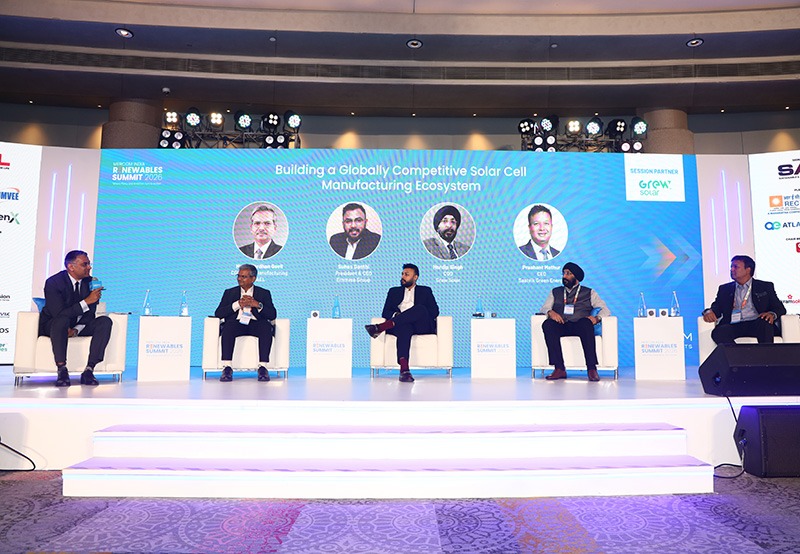
At a panel discussion “Building a Globally Competitive Solar Cell Manufacturing Ecosystem” at the Mercom India Renewables Summit 2026, industry experts said India’s module manufacturing capacity has expanded well beyond the demand. The session was moderated by Sishir Garemella, Head of International Business Development at Kiwa PVEL.
As of March 2026, India had 30.8 GW of operational solar cell manufacturing capacity, with more than 270 GW in the pipeline, including announced and under-development projects. TOPCon technology accounts for 85% of the upcoming pipeline.
Suhas Donthi, President and CEO at Emmvee Group, said module manufacturing capacity exceeded domestic demand by more than three-and-a-half times in the financial year 2026. However, he said the situation is different for cells, as the market is still adjusting to ALMM List-II.
Addressing concerns about cell shortage, the panelists said that a large portion of utility-scale projects that were bid out before August 2025 remain exempt from ALMM List-II until completion. Such projects can take up to three years to execute due to land, connectivity, and infrastructure challenges.
The immediate additional demand from ALMM List-II is expected to come largely from the commercial and industrial segment.
Donthi cautioned against assuming that India is facing a domestic cell shortage, noting that the policy had been in force for only a month and the market was still settling.
No Overcapacity Concerns
According to Mercom India, about 32% of the 270 GW cell manufacturing pipeline is expected to be commissioned in 2027. However, panelists said India is unlikely to face immediate overcapacity despite the large number of capacity announcements.
Harsh Vardhan Govil, Chief Operating Officer of Solar Manufacturing at SAEL, said overcapacity is not expected in the cell manufacturing segment because executing solar cell facilities takes time.
Of the roughly 30 GW of current cell capacity, only around 10 GW is TOPCon. This leaves room for more advanced cell capacity and provides significant headroom for growth.
Prashant Mathur, Chief Executive Officer at Saatvik Green Energy, said India has enough room for cell manufacturing capacity to grow to 70-80 GW. He added that the overall solar market could reach 80-100 GW annually over the next few years.
He said the country still has a large pipeline of non-DCR and ALMM-exempt projects under implementation. This gives module manufacturers time to upgrade and enter cell manufacturing.
Panelists said the next stage of industry evolution will shift from cells to wafers and ingots. Manufacturers must begin planning for upstream integration now, as policy timelines for localization are already approaching.
Cell Quality Still Evolving
As India’s solar cell manufacturing sector rises to meet demand under ALMM List-II, concerns remain about the quality of domestic solar cells compared with imported ones.
Panelists said Indian cell quality is still evolving and is not yet on par with Chinese manufacturers’. However, they described the current quality as workable.
Mathur said the quality and efficiency of Indian cells will improve as the domestic ecosystem develops, workers are trained, and manufacturers gain operational experience.
He compared the current stage of Indian cell manufacturing to the earlier evolution of India’s module manufacturing industry, in which the quality and price gap with Chinese manufacturers narrowed over time.
Manpower Shortage
Panelists identified skilled manpower as one of the biggest challenges for India’s cell manufacturing ambitions.
Hardip Singh, COO at Grew Solar, said India does not yet have enough formal academic or technical training programs dedicated to solar cell manufacturing. Some institutions have started offering solar manufacturing courses, but these efforts remain limited and insufficient.
Singh said the industry must work with academia, technical institutes, and skill development centers to build a qualified workforce for cell manufacturing.
To address the skills gap, he said Grew Solar partnered with Chinese companies setting up solar cell facilities to train the local workforce.
Donthi said manufacturers cannot simply borrow talent from equipment suppliers. They must build internal capabilities to operate, improve, and optimize cell lines.
He identified talent creation, technology selection, and process mastery as the key drivers of successful cell manufacturing.
R&D Gap Must be Addressed
Panelists said India must invest more in research and development to become globally competitive.
Singh said India’s R&D gap with China is evident in solar patents. He said India has only a few hundred solar-related patents, while China has tens of thousands.
He said India is still focused on catching up with existing technologies, while China continues moving to the next generation.
Panelists said backward integration is becoming a natural and necessary outcome for India’s solar manufacturing industry.
Govil said only integrated manufacturers are likely to survive in the long run. He added that module manufacturers need to look beyond modules and cells and develop a broader manufacturing ecosystem.
He said that India is not paying enough attention to developing domestic materials, equipment, and ancillary manufacturing capabilities. Investors are announcing cell and module capacities, but India is not building the supporting ecosystem at the required scale.
Govil said India lacks strong basic research and innovation infrastructure for solar manufacturing. The country must develop equipment, processes, and people capable of handling more complex manufacturing technologies.
Without this, India will struggle to compete outside its protected domestic market, he said.
Cost Competitiveness
Panelists stressed that backward integration alone is not enough. Companies must also become cost competitive.
They said domestic suppliers must lower costs. Otherwise, manufacturers will continue to prefer imports wherever duties do not make them uneconomical.
Govil said cost competitiveness is the central issue for Indian solar manufacturing.
He said India is currently able to survive largely because the domestic market is protected by government policy. However, manufacturers cannot access global markets unless they compete with China on cost and quality.
According to him, export opportunities in the U.S. have emerged partly due to restrictions on Chinese products. However, long-term global competitiveness will require more than geopolitical advantages.
Singh said solar manufacturing must become cost-competitive but expecting India to reach global cost competitiveness within two or three years is unrealistic.
He said India may not be able to match China’s pricing immediately, but it can become a credible China+1 manufacturing base by delivering quality products at reasonable prices.
Global buyers are increasingly looking for alternatives to China, he added. India can capture this opportunity by improving quality, strengthening supply chains, and offering competitive pricing.
Donthi said scale and integration can provide advantages but may not fully offset pricing distortions in the global solar value chain.
He said several materials in the solar value chain are sold at negative margins globally. Many costs, including the cost of capital and returns required for rapidly changing technologies, are also not fully reflected in prices.
However, manufacturers in India are answerable to capital markets and investors, especially listed companies, while competitors in other markets may operate under different financial conditions.
Donthi said duties alone have not been sufficient globally to create a level playing field. India’s basic customs duty did not fully address the issue, while ALMM has been more effective in driving domestic manufacturing.
China-Dependent Supply Chain
Module manufacturers said India continues to depend on China for equipment, technology updates, and many materials. Domestic ancillary suppliers are emerging, but their products often remain more expensive than Chinese alternatives.
Mathur said most manufacturers continue to evaluate Chinese equipment because it is cost-effective and widely used. However, alternatives are available outside China, and companies are also considering them to reduce geopolitical and supply chain risks.
He added that unless China restricts technology exports, many manufacturers are likely to continue procuring equipment from Chinese suppliers.
Module manufacturers expect 2026 to be a year of realignment.
Mathur said the real momentum from utility-scale demand is likely to emerge from April or May 2027.
Govil said incremental cell capacity is expected to enter the market this year and it could double next year.



Melvin Mathew
More articles from Melvin Mathew.